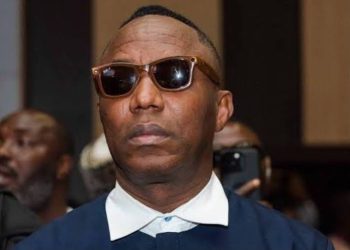
The Department of State Services, DSS, arraigned Omoyele Sowore, a politician and online publisher, at the Federal High Court in Abuja on Tuesday over alleged cybercrime offences, with the court warning him against making statements that could undermine national security.
Justice Mohammed Umar, presiding over the case, warned that any violation of this order could lead to the revocation of the bail previously granted to Sowore.
The arraignment follows two earlier attempts that were delayed due to legal objections raised by Sowore’s lawyer, which DSS counsel Akinolu Kehinde SAN, described as procedural hurdles.
Justice Umar acknowledged on Tuesday that Sowore had previously been granted bail and that his international passport remained in the custody of the court. On that basis, the judge approved bail on self-recognition.
Sowore’s lawyer, Marshall Abubakar, had filed a bail application immediately following his client’s arraignment on a five-count charge.
The charges include allegations of defaming President Bola Tinubu through posts on social media platforms X and Facebook, referring to him as a criminal.
When the charges were read, Sowore pleaded not guilty to all counts. The charges filed by the DSS cite contraventions of the Cybercrimes (Prohibition, Prevention, etc.) Amendment Act, 2024, and the Criminal Code Act.
ALSO READ: Court delays Sowore’s arraignment after service dispute
The two other parties implicated in the case are X Incorp (formerly Twitter) and Meta (Facebook) Incorp, listed as co-defendants in the case file FHC/ABJ/CR/484/2025.
Justice Umar emphasized that the court’s directive aims to ensure national peace and security while allowing Sowore to participate in legal proceedings without restriction on his movement, as long as he refrains from making statements that could incite public unrest.
The DSS stated that the charges reflect ongoing efforts to address cybercrime and social media misconduct, highlighting the role of digital platforms in public discourse.
Sowore, who ran for the presidency under the African Action Congress in 2019 and 2023, faces scrutiny for posts made online that allegedly defamed the sitting president.
The court’s ruling on bail and restrictions on public statements signals the judiciary’s approach to managing cybercrime cases that involve high-profile individuals and sensitive national security matters.
Crediblenewsng.com