The military establishment descended on Ilorin on Thursday in a show of force that Kwara State Governor AbdulRahman AbdulRazaq described as “a great relief” — but which security analysts say should have come much sooner.
The Chief of Defence Staff, General Olufemi Oluyede, and the Chief of Army Staff, Lieutenant General Waidi Shaibu, formally flagged off Operation Savannah Shield at the Sobi Barracks in Ilorin, establishing it as the operational headquarters of a new multiagency military campaign covering the entirety of Kwara State and parts of neighbouring Niger State.
The operation, approved by President Bola Tinubu, brings together the Army, Navy, and Air Force in what the CDS described as a coordinated, intelligence-driven response to a security emergency that has been quietly escalating for over a year.
The immediate trigger for the operation was the devastating attack on the villages of Woro and Nuku in Kaiama Local Government Area on the evening of February 3, 2026 — an assault so brutal it drew condemnation from the United Nations, the United States, Turkey, and the African Union.
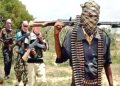
Hundreds of militants, widely attributed to the Sadiku faction of Boko Haram and, by some accounts, the Islamic State-affiliated group Lakurawa, converged on the predominantly Muslim communities at approximately 5:30 p.m. The attack — preceded by letters demanding residents adopt the militants’ version of Sharia law — lasted nearly ten hours, ending only around 3:00 a.m. when soldiers finally arrived.
By then, the carnage was already done. Between 162 and 200 people were dead, according to the Red Cross and local parliamentarians. Victims were bound and executed, burnt alive in their homes, and in some cases had their throats slit.
Thirty-eight people were abducted, including members of the family of village head Alhaji Salihu Umar, whose palace was razed to the ground. More than 50 survivors were hospitalised. Entire families were wiped out; among the dead were the village’s chief Imam, a school principal, a headmistress, and schoolchildren.
The Critical Threats Project described it as the deadliest jihadist attack of the decade outside of northeast Nigeria, and the single deadliest attack in the country in 2026.
Governor AbdulRazaq, who visited Woro and Nuku the following day, called it a “brutal and deliberate massacre” and a genocide. Former Governor Bukola Saraki labelled it a “national disaster.” President Tinubu, who ordered an army battalion to Kaiama within 24 hours of the assault, called it “particularly disturbing” because the villagers were killed for daring to resist forced indoctrination.
Also Read: Kwara raises relief committee for Woro Community
Critically, the attack did not come without warning. Survivors told journalists that jihadists had been preaching in border communities for months, issuing letters — the last delivered in January — demanding ideological submission. A warning letter sent five months earlier had prompted a brief military deployment that was subsequently withdrawn. Amnesty International condemned what it described as serious security lapses, saying the attackers had “free rein” for hours despite the prior alerts.
A State Under Siege: The Year That Was Ignored
What makes the Woro massacre even more alarming is that it was the climax of a security deterioration that had been building across Kwara State throughout 2025 — a state long regarded as one of Nigeria’s least terror-affected zones.
According to analysis by data intelligence firm Dataphyte, between January 2025 and February 2026, more than 300 people were killed across Kwara State — a figure sixteen times higher than the state’s average annual death toll over the preceding decade. Data from the Armed Conflict Location & Event Data Project (ACLED) shows that the number of violent incidents in the state increased by 78 per cent between 2024 and 2025, while fatalities surged by a staggering 921 per cent over the same period.
From January 1 to November 7, 2025 alone, at least 207 people were killed and 177 abducted, mostly in the state’s northern areas, according to the International Crisis Group. By year’s end, total fatalities had climbed to 235 — the highest figure recorded in Kwara State in a decade.
In the first eight months of 2025, two separate bandit raids claimed 17 and 34 lives, respectively. In October, another attack struck communities in Ifelodun Local Government Area. On October 29, 2025, the Sahel-based jihadist group JNIM (Jama’at Nusrat ul-Islam wa al-Muslimin) publicly claimed its first attack in Kwara State, killing a soldier and seizing weapons and cash — a declaration that analysts say signalled an alarming geographic expansion of the Sahelian jihad southward into Nigeria’s hinterland.
In November 2025, amid mounting public pressure following a wave of mass abductions across the north-central region, President Tinubu declared a “nationwide security emergency.” The Kwara State government, for its part, announced the deployment of forest guards to communities in Kwara North in December 2025. Several of those guards were subsequently killed in attacks.
The Ungoverned Forests Behind the Violence
The strategic geography of Kwara North helps explain why armed groups have found it so fertile a theatre of operations. The state contains approximately 1.7 million hectares of natural forest reserves, stretching into neighbouring states and across international borders into the Republic of Benin and Niger State. At the centre of this landscape is the Kainji Lake National Park, a 5,341-square-kilometre forest reserve that security officials now acknowledge has become a staging ground for multiple armed networks.
Among the groups believed to be operating from the forests around Kainji are the Sadiku faction of Boko Haram; the Mahmuda group, a splinter cell with links to Boko Haram and ISWAP that has been active in Borgu LGA of Niger State and Baruten LGA of Kwara State since at least April 2025 (its leader was arrested in August 2025); JNIM, which has extended its reach from the Sahel through Benin’s border communities; and Lakurawa, which Nigeria designated a terrorist organisation in January 2025 and which is suspected to be affiliated with the Islamic State Sahel Province.
Geospatial analysis by Dataphyte found that many communities in Kwara North — particularly in Baruten, Edu, Kaiama, Moro, and Patigi local government areas — are located several kilometres from the nearest police station, creating dangerous response time deficits whenever attacks occur.
“These ungoverned or under-governed spaces provide logistical depth, mobility routes, and concealment advantages,” said Kabir Adejumo, a senior researcher at Good Governance Africa. “Once armed actors establish operational footholds in such areas, spillover attacks into nearby rural communities often follow.”
Operation Savannah Shield: A Structured Campaign or Another Surge?
Against this grim backdrop, the flag-off of Operation Savannah Shield on Thursday was met with cautious optimism.
The CDS, General Oluyede, was unambiguous about the mandate. “Operation Savannah Shield is a proactive and coordinated response,” he told reporters after the flag-off. “Its primary mandate is to secure lives and property, neutralise terrorist and criminal elements, disrupt kidnapping networks and restore law and order within the joint operational area.”
He placed special emphasis on the Kainji National Park, saying troops would sweep through its forests to dislodge the criminal networks that have long used it as a transit and staging ground. He pledged a combination of “kinetic and non-kinetic measures” — including targeted operations, strategic communication, and community engagement — and, in a pointed assurance to a state that has grown frustrated with temporary military surges, stressed: “This is not a temporary surge but a structured and sustained campaign.”
The CDS also called on traditional rulers, youth leaders, and community stakeholders to support the operation with “credible information,” noting that security is a shared responsibility.
For Governor AbdulRazaq, Thursday’s ceremony represented both vindication and relief. He thanked President Tinubu for responding swiftly to what he called a “distress call,” and underscored a dimension of the crisis often overlooked in security discourse: its threat to food production.
“These go beyond national security,” the Governor said. “We are driving into the road of food security because the vast area in which this operation command will cover is our farming belt, and farmers have been challenged with the ongoing disturbances.”
The House of Representatives has also formally backed the operation, with Deputy Spokesperson Abubakar Agbese rallying public support and urging community cooperation with the joint task force.
The Road Ahead
Nigeria’s north-central zone has increasingly become a new frontier in the country’s long-running battle with armed extremism. Kwara, which serves as a geographic bridge between the north and the southwest, now sits at a dangerous inflection point — one that analysts warn could have cascading implications for the country’s broader security architecture if left unaddressed.
For the families of Woro and Nuku, still counting their dead and searching for those abducted, the arrival of troops is welcome but belated. The question now is whether Operation Savannah Shield will deliver the “structured and sustained campaign” its commanders have promised — or become yet another entry in a long record of responses that came too late and stayed too briefly.
Crediblenewsng.com