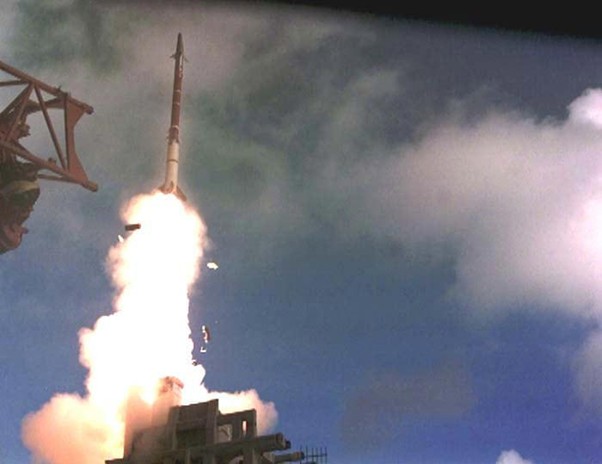
On the night of the 21st, Israel’s air defence system, which failed to intercept two Iranian ballistic missiles, was identified as the medium-range missile system David’s Sling.
Analysts speculate that Israel might have opted to deploy David’s Sling instead of the high-cost long-range interceptor missile Arrow-3 to conserve the latter, resulting in the interception failure.
According to a 23rd Israel Air Force, IAF, investigation, two ballistic missiles launched by Iran on the night of the 21st struck Dimona and Arad, southern cities housing nuclear facilities. The attacks caused approximately 200 injuries and significant structural damage. The Iranian missiles were identified as the Ghadr-class, carrying hundreds of kilograms of explosives but not cluster munitions.
The region is one of Israel’s most heavily fortified with air defence systems. At the time, David’s Sling, a mid-range system, was used instead of the long-range Arrow-3. Investigations revealed that while David’s Sling detected the missiles and launched interceptors, it ultimately failed to neutralize them.
Also Read: IDF reacts to Hezbollah rocket barrage in northern Israel
Israel maintains a multi-layered air defence network: Iron Dome (70 km range) for short-range rockets, David’s Sling (approx. 300 km) for mid-to-long-range missiles, and Arrow for long-range threats. The Arrow-3, with a maximum range of 2,400 km, is designed to intercept missiles outside the atmosphere, forming the top-tier defence layer.
While Arrow-3 is conventionally tasked with intercepting such threats, Israel deployed David’s Sling. Some analysts argue that Israel chose the mid-range system to preserve costly Arrow-3 interceptors, leaving its defences breached. Each Arrow-3 missile costs approximately 2.5 million dollars (about 3.7 billion Korean won), compared to David’s Sling’s 1 million dollars (about 1.5 billion Korean won) per unit.
The Israel Defence Forces insists its systems have no flaws. The IAF stated, “David’s Sling has previously intercepted Ghadr-class missiles.” In May of last year, David’s Sling demonstrated its capability by downing a missile launched from approximately 1,500 km away. In February, it completed a range extension upgrade to counter Iranian ballistic missiles.
However, concerns persist about secondary damage from debris during low-altitude interceptions. A source told Israeli media Walla, “To neutralize Iranian missiles, interception must occur outside the atmosphere. No matter how expanded David’s Sling’s capabilities are, only Arrow-3 is the solution. Currently, debris damage across Israel is widespread and not fully accounted for.”
Since the outbreak of the Iran-Israel conflict, Iran has fired over 400 ballistic missiles toward Israeli territory, with the IDF claiming to have intercepted approximately 92% of them.
MSN