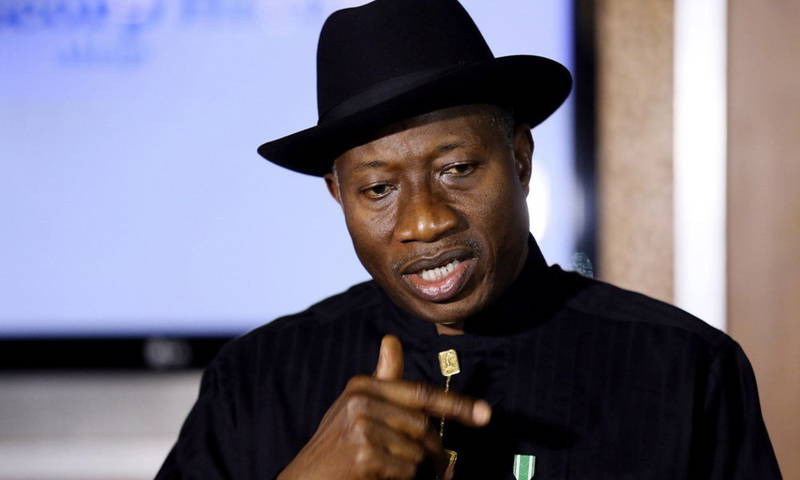
Former President Goodluck Jonathan on Friday challenged a suit filed before a Federal High Court in Abuja by a lawyer, Johnmary Jideobi seeking to restrain him from contesting the 2027 presidential election.
Jonathan, through his lawyer, Chief Chris Uche, SAN, told the trial judge, Justice Peter Lifu, shortly after the matter was called for hearing, that a letter of conditional appearance, a notice of preliminary objection, a counter-affidavit, and a written address had been filed on May 5, praying the court to dismiss the case.
He said they got information about the case through the media, hence the need to file their processes urgently, considering the importance of the matter, which centres on the eligibility of the former president to contest the 2027 presidential election.
Uche said it was unfortunate that such a suit was filed by a lawyer who should know that the same matter had already been decided by both the Federal High Court and the Court of Appeal.
Earlier, counsel to the plaintiff, Ndubuisi Ukpai, informed the court that the matter was for mention, but that he had just been served with Jonathan’s processes and would need time to study them to enable him respond appropriately.
Justice Lifu adjourned the matter till Monday, May 11, by 2 p.m. for hearing of the former president’s objection and the substantive suit.
The judge also ordered that hearing notices be issued and served on the Independent National Electoral Commission, INEC, and the Attorney General of the Federation, AGF, who are the 2nd and 3rd defendants in the matter and were not in court.
The plaintiff had filed the case seeking an order restraining Jonathan from presenting himself to any political party as a candidate for the 2027 election.
Jideobi is also asking the court to stop INEC from accepting, processing, or publishing Jonathan’s name as a presidential candidate.
Also Read: Yar’Adua as gentleman president, Jonathan pays tribute
In the suit, the plaintiff asked the court to determine whether, based on Sections 1,1, 2, 3, and 137, 3 of the 1999 Constitution, Jonathan remains eligible under any circumstances to contest for Nigeria’s highest office again.
According to the plaintiff, Jonathan had already exhausted the constitutional limit for the office after completing the tenure of late President Umaru Musa Yar’Adua and subsequently serving a full four-year term following the 2011 election.
An affidavit filed in support of the suit by Emmanuel Agida stated that Jonathan assumed office as president on May 6, 2010, after Yar’Adua died a day earlier.
Agida said reports suggesting that Jonathan may be interested in the 2027 election informed the decision to approach the court with the suit.
“The plaintiff believes that the 1st defendant, having completed the unexpired term of late President Yar’Adua and subsequently served a full term after the 2011 election, has exhausted the constitutional limit of two tenures as president,” the affidavit stated.
The plaintiff further argued that unless the court intervenes, a political party could nominate Jonathan for the election in violation of constitutional provisions.
According to the affidavit, if Jonathan contests and wins the election, he would be taking the presidential oath of office for the third time.
Agida maintained that the suit was filed in the public interest to uphold the supremacy of the Constitution and preserve the integrity of Nigeria’s constitutional order.
Jonathan had earlier said he was consulting on whether or not he should join the 2027 presidential race.
NIGERIAN TRIBUNE