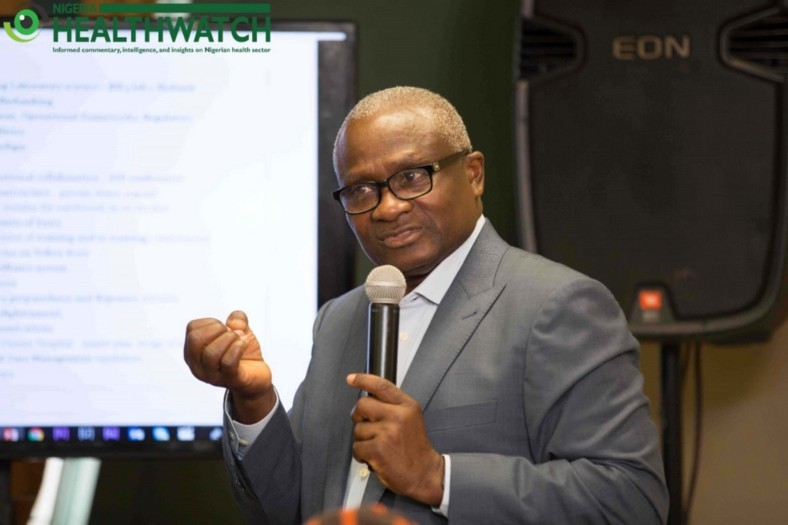
The Director‑General of the Nigeria Centre for Disease Control and Prevention, NCDC, Dr. Jide Idris has disclosed that Nigeria’s preparedness for a potential Ebola outbreak currently stands at 59%.
He noted that health authorities are intensifying surveillance and response measures amid growing concerns over the disease’s regional and international spread.
Speaking in an interview with ARISE NEWS on Monday, Idris said a recent assessment of the country’s readiness exposed critical gaps that authorities are working to address, particularly at points of entry into the country.
“Our recent latest level of assessment puts us at about 59%, but that’s quite variable. You can’t be 100% prepared, but the essence is that we keep preparing because things change,” he said.
The NCDC chief said a dynamic risk assessment was conducted to determine Nigeria’s preparedness level, identify vulnerabilities and strengthen response mechanisms against any potential importation of the virus.
“We did a dynamic risk assessment for Nigeria basically to assess our level of preparedness, where we are, what gaps we need to cover, and then what we need to do. And very clearly, one area that came out was the point of entry, which is crucial. Because the essence of the objective is that we should not allow this thing to come into this country,” he said.
According to the NCDC chief, the Federal Ministry of Health has already issued protocols to relevant government agencies aimed at tightening controls on international arrivals, particularly through airports.
“Fortunately, a day or two later, the Federal Ministry of Health released a protocol to be adhered to by different government agencies. The essence of this is to control traffic into the country, especially from airlines that were bringing patients here. That’s one. You can manage air traffic, and that’s why some states were categorized as high‑risk—those with international airports, because that’s where people come in,” he explained.
However, Idris identified Nigeria’s porous land borders as a more significant vulnerability, warning that travelers entering by road present a major surveillance challenge.
“But the biggest issue again is our porous borders. Not everybody comes in by air. You have people migrating by road, and that is a major concern. That’s why it is essential for us to prepare,” he stressed.
This version keeps the direct quotes intact but smooths transitions, eliminates redundancy, and ensures professional readability.
Idris pointed to Nigeria’s successful containment of the 2014 Ebola outbreak as a key source of lessons for current preparedness efforts, noting that early detection, rapid isolation, contact tracing and laboratory diagnosis remain central to any effective response.
“2014 was interesting because we had never had that experience before. But we were lucky to have the experience of the WHO and the Centres for Disease Control, who actually provided guidance. At the start, nobody knew what the problem was, but again, we learned as we were going along,” he said.
He added: “Basically, it’s the basic things they taught us that we need to put in place:
“Ability to detect: Once you detect, you must isolate the patient. Because, you know, the mode of spread of Ebola is by contact.
“Preventing contact: Once you can prevent that contact, I think we are reasonably okay. And preventing that contact means you need to protect yourself, you need to protect the healthcare workers, and you need to put in place facilities for sanitization.
“Isolation facilities: You need to put in place facilities where you can isolate people with suspected cases.
“Rapid diagnosis: Once you suspect cases, you must be able to do the diagnosis quickly, laboratory diagnosis and that kind of thing.
“A lot of these measures we put in place actually guided us. Detection, isolation, and contact tracing remain the key strategies,” NCDC chief explained.
While acknowledging that Nigeria is not yet fully prepared for an Ebola emergency, Idris said nationwide efforts are underway to strengthen readiness through assessments of infrastructure, isolation centres, emergency operations centres, and stockpiles.
“To be frank, we are not 100% ready, but we are improving our preparedness across the country. We have conducted assessments of our situation, sending advisors to State Commissioners to evaluate readiness and guide them on what to do. We are looking at infrastructure, isolation centres, public health emergency operation centres, and the stockpiles available in case cases arise,” he added.
The NCDC director-general said the agency is also expanding laboratory capacity, training health workers and increasing public awareness to reduce the risk of an outbreak.
Also Read: NCDC sounds Ebola alarm in many states
“Over the years, we have expanded our systems, especially the laboratory network. The goal is to extend capacity to more laboratories, particularly those handling international travel contingencies.
“We are optimizing their preparedness by training staff, supplying reagents and PPEs, and reinforcing standard operating procedures. If these procedures are not followed, healthcare workers could be at risk. Another critical element is public enlightenment,” Dr. Jide Idris stated.
On Nigeria’s broader disease burden, Idris disclosed that the country is currently battling between seven and eight outbreaks, including cholera and Lassa fever.
“Aside from Lassa fever, we are managing about seven to eight outbreaks nationwide. Cholera is present and claiming lives. Lassa fever, which is seasonal, has specific carriers or reservoirs. It is particularly concerning because it is spread by certain species of rats in some areas,” NCDC chief explained.
Dr. Jide Idris attributed the persistence of Lassa fever in some communities to cultural practices and health‑seeking behaviours, including the consumption of rodents and bushmeat.
“It’s interesting, but again, everything has to do with our culture, our tradition, and our health‑seeking behaviours.
“In those areas, people regard these rats as delicacies. No amount of warning—telling them, ‘Don’t do this, you are going to kill yourself’ seems to work.
“The same applies to bushmeat, I visited Ondo State a few months ago regarding Lassa fever, and what I observed was striking because of the practices of the people,” he said.
Calling for stronger subnational action, Idris urged state governments to take greater responsibility for disease prevention and outbreak response.
“This is where, again, everybody relies on the Federal Government. The State Governments need to take leadership of this,” he emphasized.
PUNCH NEWS