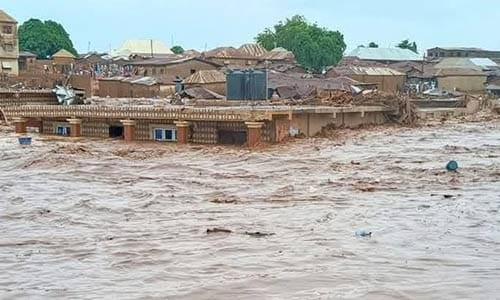
The Federal Government has issued an urgent flood warning across Nigeria, advising residents in hundreds of vulnerable communities to prepare for potential flooding as heavy rainfall is forecast between June 22 and July 5, 2026.
This alert was released in a Flood Prediction Advisory by the Federal Ministry of Environment’s National Flood Early Warning Centre.
The advisory signed by Usman Abdullahi Bokani, Director of the Erosion, Flood and Coastal Zone Management Department, identified regions in over 30 states and the Federal Capital Territory, FCT, as facing varying degrees of risk.
States expected to be impacted include Abia, Adamawa, Akwa Ibom, Anambra, Bayelsa, Benue, Cross River, Delta, Ebonyi, Edo, Ekiti, Enugu, Imo, Kebbi, Kogi, Kwara, Lagos, Nasarawa, Niger, Ogun, Ondo, Osun, Oyo, Plateau, Rivers, Taraba, and the FCT.
The ministry warned that low-lying urban centers, coastal areas, riverine settlements, and regions with inadequate drainage systems are particularly susceptible to inundation.
Major cities highlighted for vigilance include Aba, Umuahia, Uyo, Awka, Onitsha, Yenagoa, Makurdi, Calabar, Asaba, Abakaliki, Benin City, Ado-Ekiti, Enugu, Owerri, Lokoja, Ilorin, Lagos, Minna, Abeokuta, Akure, Osogbo, Ibadan, Port Harcourt, Jos, Jalingo, and Abuja.
Adamawa State was placed under a special “high-risk” category, with specific warnings for communities such as Yola North, Yola South, Numan, Mubi, Song, Shelleng, Karewa, Jambutu, Ngurore, Ribadu, Yolde Pate, and Wuro Hausa.
Also Read: Sani stakes ₦34bn to tackle flood in Kaduna
Similarly, prone locations in Lagos State includes Agege, Alimosho, Apapa, Badagry, Epe, Eti-Osa, Ikeja, Ikorodu, Kosofe, Lagos Island, Lekki, Ojo, and Surulere, are expected to require close monitoring throughout the forecast period.
According to the advisory, the increased threat is attributed to heavy rainfall likely to cause overflowing rivers, flash floods, and waterlogging.
The Ministry has issued specific directives based on risk levels. Critical communities must immediately monitor water levels, identify evacuation routes, protect vulnerable individuals, and strictly avoid activities within floodplains or drainage channels.
High-risk communities are urged to intensify the clearing of blocked culverts and drains, monitor nearby waterways, and improve community-based reporting to support rapid emergency response.
The Federal Government has called on state and local governments, as well as emergency management agencies, to activate contingency plans and conduct public awareness campaigns to minimize the impact of the predicted flooding.
RADDARNEWS.COM