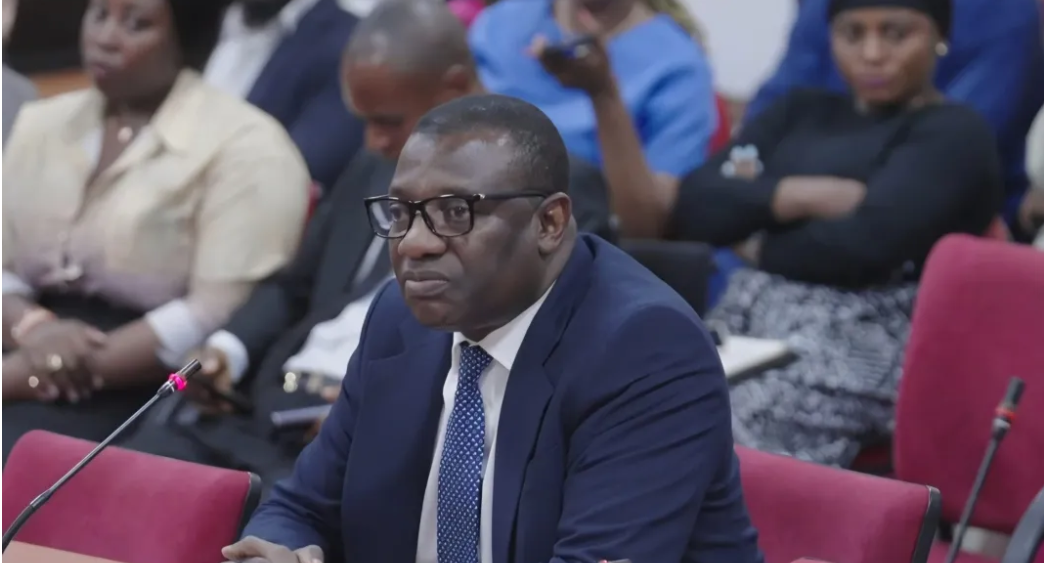
A former Group General Manager of the National Petroleum Investment Management Services National Petroleum Investment Management Services, NAPIMS, Alhaji Bala Wunti, has told the Senate that there is no evidence in the Nigerian National Petroleum Company Limited’s 2023 Audited Financial to support claims that ₦210 trillion is missing from the company’s accounts.
Appearing before the Senate Committee reviewing the NNPC’s 2023 financial statements, Wunti said he had undertaken a page-by-page examination of the audited accounts at the committee’s request and found that the widely circulated ₦210 trillion figure resulted from a misinterpretation of accounting entries rather than evidence of missing funds.
“I have gone through page to page of this document. I have not found where ₦210 trillion was mentioned,” Wunti told lawmakers.
According to him, the controversial figure was arrived at by adding together two separate balance sheet items that should not have been combined.
He explained that one entry, amounting to about ₦107 trillion, represented sundry receivables, funds owed to the company, while another entry of roughly ₦103 trillion represented accrued expenses, or liabilities owed by the company.
“Receivables are money other people owe you. Accrued expenses are money you owe other people. Accounting standards require that these items be reported separately. They cannot simply be added together and described as missing money,” he said.
On the strength of his review, Wunti declared under oath that there was no basis for the allegation that ₦210 trillion had disappeared from the NNPC’s books.
The Senate committee had invited the former NAPIMS chief after directing him to independently review the company’s audited financial statements and submit his observations.
Wunti told lawmakers that although his tenure did not cover the entire period under review, it fell substantially within the timeframe being examined, placing him in a position to assess the accounting issues before the committee.
In his presentation, he sought to explain what he described as the unique accounting architecture of national oil companies.
Unlike conventional commercial enterprises, he said, national oil companies perform multiple statutory responsibilities simultaneously.
According to him, NNPC Limited functions as a commercial enterprise, serves as trustee of the federation’s oil and gas assets and discharges strategic responsibilities aimed at safeguarding Nigeria’s energy security.
Also Read: Former NNPCL CFO refutes claims of missing ₦210tn
Balancing these three mandates, he said, requires different accounting books and reporting frameworks, making the company’s financial reporting inherently more complex than that of an ordinary commercial entity.
He explained that before the enactment of the Petroleum Industry Act, the former NNPC combined commercial, regulatory and policy-making functions within a single organization.
The PIA, he noted, sought to separate many of those responsibilities, although the company still maintains distinct accounting records to reflect its commercial activities and its management of assets held on behalf of the federation.
Wunti, who headed NAPIMS from March 2020 before later serving as Chief Offshore Investment Officer of the NNPC Upstream Investment Management Services until December 2024, maintained that throughout his stewardship, there was no reported fraud and no missing funds.
He also addressed another issue before the committee concerning the cost of incorporating NNPC Limited following the implementation of the Petroleum Industry Act.
According to him, reports claiming that ₦5.8 billion was spent on the incorporation were inaccurate.
He said the actual statutory payments made to the Corporate Affairs Commission and the Federal Inland Revenue Service for filing fees and stamp duties amounted to about ₦2.45 billion.
He explained that the larger figure circulated publicly resulted from entries made in separate accounting books because one arm of the organization executed the payment on behalf of government shareholders while another recorded the same transaction for statutory reporting purposes.
“The only money paid was about ₦2.45 billion and it went directly to government institutions. No third party received any payment,” he said.
Wunti urged closer coordination between NNPC Limited, the Office of the Accountant General of the Federation and the Office of the Auditor General of the Federation to improve understanding of the company’s accounting framework and minimize future controversies.
He also recommended a more comprehensive reading of the Constitution, the Petroleum Industry Act and other relevant statutes to ensure a better appreciation of the legal obligations under which NNPC Limited operates.
Following his presentation, Chairman of the Senate Committee, Senator Ibrahim Dankwambo, said members would study Wunti’s written report alongside the audited financial statements before deciding whether to invite him back for further clarification.
The committee subsequently adjourned to enable members examine the submission in detail as the Senate’s ongoing scrutiny of the NNPC’s 2023 audited accounts continues.
The review has drawn widespread public attention following allegations of financial irregularities and competing interpretations of figures contained in the company’s audited financial statements.