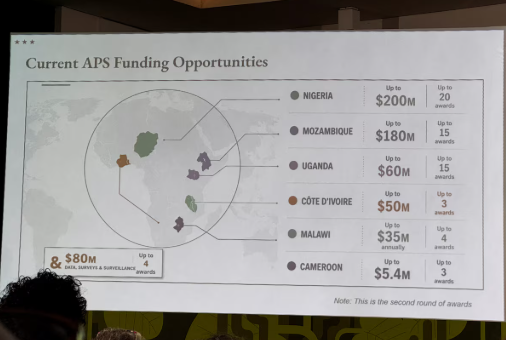
The US State Department has acknowledged an “unfortunate error” after a map displayed at the AIDS 2026 conference in Rio de Janeiro incorrectly labelled the locations of six African countries.
The map, shown during an event at the International Health Conference, highlighted Nigeria, Mozambique, Uganda, Côte d’Ivoire, Malawi, and Cameroon. However, none of the countries was correctly identified by the lines connecting their names to locations on the map.
Nigeria was depicted as landlocked, Mozambique was placed in the Horn of Africa instead of southeastern Africa, and Côte d’Ivoire was shown on the wrong side of the continent.
A photo of the incorrect map was shared in a Substack post by AIDS expert Emily Bass. According to a Reuters analysis, the image contained an artificial intelligence watermark indicating it was created using OpenAI tools.
A State Department spokesperson said on Thursday that the error occurred after a team member “hastily altered the slide deck immediately before the presentation” at the AIDS 2026 Conference.
“We take full responsibility for the confusion and misrepresentation it caused for attendees, including our African partners,” the spokesperson said.
Also Read: Trump says Washington will control Strait of Hormuz
The incident has drawn attention amid ongoing criticism of changes within the State Department under President Donald Trump’s administration.
Since Trump returned to office, the department has reduced global health funding and undergone a major restructuring that has led to the departure of several career experts.
Cameron Hudson, a former State Department and National Security Council official focused on Africa, said the mistake reflected the consequences of reduced staffing levels and weakened institutional oversight.
The error is “a reflection of what happens when you fire one-third of the State Department, eliminate multiple layers of bureaucracy and have junior staff performing work unsupervised,” Hudson said in a post on X.
“There isn’t just a cost savings when eviscerating staff and expertise. There’s a real cost in reputation and effectiveness,” he added, arguing that similar challenges could affect other areas of US foreign policy, including teams handling sensitive negotiations such as nuclear talks with Iran.
Hudson said the mistake should concern policymakers because diminished expertise and oversight could affect the United States’ ability to effectively manage international engagements.
CNN