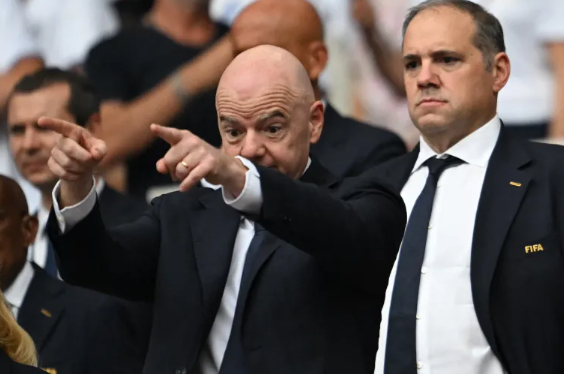
FIFA has abandoned its controversial plan to sell a minority stake in a new commercial entity managing the organisation’s major competitions, including the FIFA World Cup, following an extraordinary backlash from football’s most powerful confederations and growing opposition within FIFA itself.
FIFA President Gianni Infantino confirmed the withdrawal of the proposal after days of mounting resistance to the plan, which would have created a new subsidiary known as FIFA Forward Enterprise. The proposed company was designed to bring together FIFA’s commercial rights and the operational delivery of its major tournaments.
The proposal envisaged an initial valuation of approximately $20 billion for the new entity, with FIFA seeking to raise as much as $4.2 billion by selling minority, non-controlling interests to outside investors. FIFA maintained that it would retain control over football governance, competitions, the international match calendar and sporting and regulatory decisions.
The organisation argued that the investment would unlock additional commercial value from its enormous portfolio of broadcasting, sponsorship, licensing and ticketing rights, while allowing more money to be directed into football development around the world.
Under FIFA’s original proposal, all 211 member associations could have received access to an additional $20 million in immediate funding for special projects, while FIFA Forward funding for the 2027-2030 cycle was proposed to rise from the existing $8 million per association to $20 million.
But what FIFA presented as an ambitious financial model quickly became one of the biggest governance disputes of Infantino’s presidency.
UEFA and its 55 member associations emerged as the most forceful opponents. European football’s governing body rejected the idea of transferring ownership interests in the World Cup and other FIFA competitions to private investors and argued that the tournament should not be treated as an investment product.
UEFA’s position was particularly damaging because its 55 national associations represent a significant bloc within FIFA’s 211-member Congress. The European confederation had even threatened not to participate in FIFA competitions if the investment structure proceeded, turning what initially appeared to be a commercial restructuring into a potentially serious political crisis for world football.
The resistance did not remain confined to Europe.
CONCACAF which represents 41 member associations across North America, Central America and the Caribbean, also raised serious concerns. The confederation criticised the way the proposal had been presented and questioned the speed of the consultation process, including what it described as an extremely short deadline and the absence of sufficient review through FIFA’s established governance structures.
The Asian Football Confederation also opposed the plan. AFC President Sheikh Salman bin Ebrahim Al-Khalifa welcomed FIFA’s decision to withdraw the proposal and stressed the need for transparency and meaningful consultation when decisions could affect the future of global football.
Also Read: UK leader challenges Infantino’s future at FIFA
That opposition was significant because UEFA, Concacaf and AFC together account for a substantial majority of FIFA’s membership. Their resistance meant that Infantino was facing opposition from several of the most influential blocs in the organisation at precisely the moment he was trying to push the project towards approval.
The backlash also reached inside FIFA.
Carlos Cordeiro, a former president of the United States Soccer Federation and senior adviser to Infantino, resigned from his position amid the controversy. Cordeiro had also been involved with the White House task force connected to the 2026 World Cup.
In announcing his resignation, Cordeiro made clear that he opposed the proposed sale of part of FIFA’s commercial interests. He argued that FIFA already possessed enormous financial resources and questioned why the organisation needed to give private investors an ownership stake in one of the most valuable sporting properties in the world.
His departure was particularly embarrassing for Infantino because Cordeiro was not an outside critic. He was a senior adviser to the FIFA president.
FIFA’s own chief operating officer, Kevin Lamour, also became associated with internal criticism of the proposal, adding to concerns about the level of transparency and consultation surrounding the initiative.
The proposed investors were another source of scrutiny.
The investment structure was expected to involve private capital and was linked to Thrive, the investment firm associated with Joshua Kushner. The proposal’s financial architecture was being developed with major financial institutions involved in the process, while FIFA argued that investors would only hold minority, non-controlling positions.
FIFA insisted that it was not selling control of the World Cup.
That distinction became central to Infantino’s defence of the project. The governing body said FIFA would continue to own and control its competitions and retain authority over football’s sporting and regulatory decisions.
Critics, however, argued that the issue went beyond legal control.
For UEFA and other opponents, allowing private investors to own a stake in the commercial entity responsible for the World Cup and other FIFA competitions would fundamentally change the relationship between football’s governing body and the commercial interests surrounding the sport.
The controversy therefore became a debate about much more than money.
It raised questions about who should benefit from the extraordinary commercial value generated by the World Cup, whether private capital should have an ownership interest in FIFA’s most important competitions and how major decisions affecting global football should be made.
FIFA had argued that the proposed investment could generate more resources for football development.
According to FIFA’s original announcement, the new structure could help increase development funding to more than $10 billion over future cycles. The organisation said additional money could be used for stadiums, training centres, infrastructure, coaching, national teams, competitions, grassroots football and the women’s game.
The governing body also maintained that any net benefits generated by FIFA Forward Enterprise would be reinvested into football worldwide.
But the financial argument failed to overcome the governance concerns.
The speed of the proposal became one of the biggest complaints. Opponents questioned why such a fundamental restructuring of FIFA’s commercial operations had emerged so quickly and why confederations and national associations were not sufficiently involved before the plan was presented.
That issue became particularly important because FIFA had originally been working towards a September 19 deadline for member associations to approve the proposed structure.
The collapse of the proposal therefore represents a significant reversal.
Only days earlier, FIFA had been defending the initiative and arguing that critics were misrepresenting its intentions. Infantino had maintained that FIFA was seeking to maximise the commercial potential of football rather than sell the sport itself.
But after listening to the various objections, Infantino acknowledged that the proposal had created divisions that were no longer compatible with FIFA’s objective of uniting the game.
The FIFA president said the project would therefore not proceed and indicated that the organisation would seek to bring stakeholders back together to discuss ways of continuing to grow football, particularly in countries that require greater financial support.
For Infantino, however, the political consequences may extend beyond the failed investment proposal.
The episode has exposed a rare level of resistance to his leadership. UEFA, CONCACAF and AFC all expressed serious concerns, while an influential senior adviser resigned and internal criticism emerged within FIFA.
It also comes as Infantino looks towards the next FIFA presidential election in 2027. Although he has previously enjoyed strong political support within the organisation, the investment controversy has created a new debate about his leadership style, FIFA’s decision-making processes and the extent to which the president can pursue major commercial reforms without broad support from the confederations.
The episode has also highlighted the importance of the World Cup to FIFA’s financial strength.
The 2026 tournament in the United States, Canada and Mexico was the largest World Cup in history, featuring 48 teams. FIFA has significantly expanded the financial distributions associated with the tournament, with the organisation announcing a total distribution of $871 million to the participating member associations.
That commercial strength was at the heart of Infantino’s argument: FIFA believes its most valuable sporting property still has enormous room for commercial growth.
But the failed investment plan demonstrates that extracting more commercial value from the World Cup is not simply a financial question.
For FIFA’s confederations and member associations, the bigger question is who controls that value, how decisions involving it are made and whether private investors should ever receive a stake in the commercial machinery behind the world’s biggest football tournament.
The immediate consequence is clear: FIFA Forward Enterprise will not move forward in the form proposed, the planned private investment will not take place and the proposed $4.2 billion capital raise has been shelved.
The wider consequences are less certain.
FIFA still wants to increase development funding and expand the commercial value of its competitions. The governing body will therefore have to find another mechanism for achieving those objectives without reigniting the same opposition.
The failed proposal may also force Infantino to rethink how FIFA handles major structural decisions.
What began as an attempt to raise billions of dollars for football development ended with UEFA, Concacaf and AFC united in opposition, an adviser walking away and FIFA ultimately abandoning the project.
For now, the World Cup remains under FIFA’s control without the proposed private ownership structure.
But the controversy has left an important question hanging over world football: how far can FIFA go in commercialising the world’s most valuable football tournament before its members decide that the business has gone too far?
Crediblenews.ng