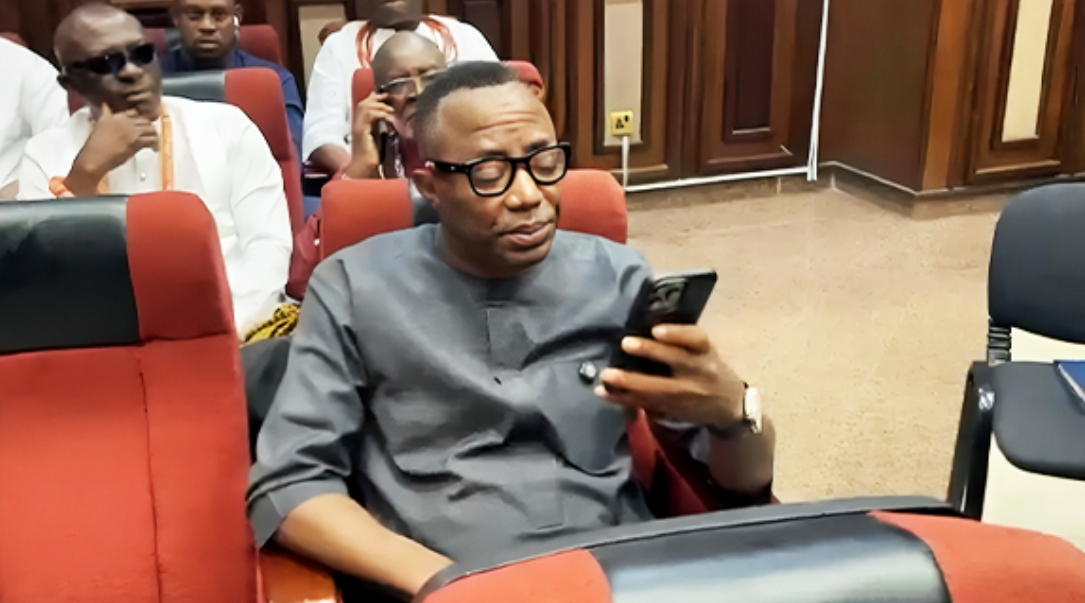
The Department of State Services, DSS, on Monday renewed its push to have the Federal High Court in Abuja foreclose the defence of Omoyele Sowore, accusing him of deliberately stalling his trial on charges of criminal defamation, cyberstalking and incitement.
The charges stem from social media posts Sowore made last year in which he described President Bola Tinubu as a “criminal” — posts the DSS contends cross the line from political commentary into punishable cybercrime.
The case has become yet another flashpoint in the long-running legal battle between the security agency and the activist-turned-politician, who has faced repeated detention and prosecution since his 2019 arrest under the Administration of Criminal Justice Act over his #RevolutionNow protest campaign.
DSS counsel Akinloku Kehinde, SAN, made the foreclosure application before Justice Mohammed Umar after Sowore’s lawyer, Adeyinka Olumide-Fusika, SAN, sought an adjournment, arguing that he was unprepared to proceed with the cross-examination of a subpoenaed DSS witness.
When the case was called, Olumide-Fusika informed the court that the matter was scheduled for continuation of defence and confirmed that a DSS officer had appeared to represent the Director General of the Service, Mr Oluwatosin Ajayi. He, however, told the court that “it will not be possible for us to proceed.”
His explanation: an application filed on July 22 requesting the judge to attest to documents he intended to use in leading the subpoenaed witness had only just been granted — and he discovered this only minutes before the sitting began.
Also Read: Sowore gets final chance to defend cybercrime charge
“We filed an application on 22 July, 2026, and we were told that your lordship had not approved it. We only discovered that the court approved it since 27th July, few minutes before the court began sitting,” Olumide-Fusika said, placing the blame on the court registry for the communication gap.
Kehinde swiftly opposed the excuse, characterising it as part of a pattern of dilatory tactics designed to prolong the trial.
He reminded the court that at the last adjourned date, all parties had agreed that a nominated officer from the DG of the DSS would appear to testify for the defence — an undertaking the prosecution had fulfilled. The witness was in court, he said, specifically to be cross-examined on Exhibit DW-D, which was tendered on July 22.
“It is trite that when an application is made to the court in a case by the defence, it is the responsibility of the applicant to follow up,” Kehinde argued.
The senior lawyer urged the court to foreclose Sowore’s case, submitting that the court had repeatedly granted him opportunities that had been “deliberately and persistently frustrated.” The court, he argued, was entitled to invoke its discretionary case-management powers to bring the matter to a close.
Crucially, Kehinde contended that foreclosing the defence would not breach Sowore’s constitutional right to fair hearing. Relying on Section 36(4) and (6) of the 1999 Constitution (as amended), he argued that the Constitution guarantees an opportunity to be heard — not an unlimited right to delay proceedings.
He anchored the argument in a 2011 Supreme Court decision in Segun Ogunsanya v. The State, in which the apex court held that deliberate attempts to stall a trial should not be entertained. Kehinde therefore urged the court to make a consequential order directing parties to file their final written addresses.
Olumide-Fusika disagreed, accusing the prosecution of sidestepping the facts placed before the court and blaming every procedural snag on the defence — including the DSS’s own conduct regarding the subpoenaed witness.
On the prosecution’s argument that the defence ought to have followed up on its application, he countered that the defence was not in a position to determine when the judge signed the request, since communication flows through the registry, not directly between counsel and the bench. He cited Sections 4 to 13 of the Evidence Act in support.
He also noted that if he had truly intended to delay proceedings, he would not have appeared in court at all, given that the court had already commenced its annual vacation.
“If he (Kehinde) doesn’t want to cooperate with me, and he wants us to be fighting—” Olumide-Fusika began, before the judge cut in.
Justice Umar drew attention to the fact that he had only recently taken over the case and reminded the senior lawyer that the defence had been delaying the matter since March, when the prosecution closed its case.
“I have been on the Bench for 22 years. We have junior counsel here. This is not good. This should be the last time. If you are no longer interested in the case, you should say so,” the judge warned, adding firmly: “You cannot behave in my court in that manner.”
Justice Umar subsequently adjourned the matter until September 20 for continuation of the defence — granting Sowore what may be a final window to present his case before the court considers the DSS’s foreclosure application.
Crediblenewsng.com