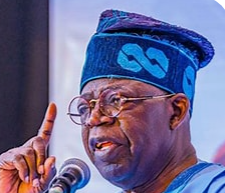
President Bola Tinubu on Thursday directed the Economic and Financial Crimes Commission, EFCC, to vacate an order freezing a bank account belonging to the Osun State Government, describing the timing of the anti-graft agency’s action — just 10 days before the state’s governorship election — as “inauspicious” and “deeply embarrassing.”
In a personally signed State House statement, the President said that while he had deliberately refrained from interfering in the operations of law enforcement agencies since assuming office, the circumstances of the Osun matter compelled him to act in the “overriding public interest in preserving public confidence and the integrity, credibility, and fairness of our democratic process.”
“Osun State is only a few days away from its gubernatorial election. Therefore, nothing ought to be done to give the impression that the EFCC or indeed any other agency of the federal government is being used to interfere with the election,” the President stated, adding that he had directed the commission to “discontinue whatever action it has instituted against the Osun State Government in this regard.”
Ola Olukoyede, the EFCC Chairman ran into trouble, apparently taking orders from politicians. On Wednesday, the Osun State Government disclosed that the EFCC had placed a “Post No Debit” restriction on a state government account domiciled with First Bank — an account officials said is used for the payment of workers’ salaries.
Governor Ademola Adeleke, through his Commissioner for Information and Public Enlightenment, Kolapo Alimi, denounced the action as unlawful and politically motivated, insisting the commission had no legal basis to freeze the state’s accounts.
The EFCC later confirmed the restriction, explaining that it stemmed from an investigation opened in March 2026 into the alleged diversion and mismanagement of about ₦11 billion in Ecology Funds, Intervention Funds, and Federation Account Allocation Committee allocations.
The commission said several state officials, including the Accountant General, had been questioned, and that it was compelled to act after detecting what it called “precipitate and unwarranted” transfers of large sums from government accounts into corporate entities beginning 2 August. “The Commission cannot watch idly while a state government’s account is being pillaged,” the EFCC said, insisting the move had no connection to the election. Source
Defending the action on Arise Television, the EFCC’s Director of Public Affairs, Wilson Uwujaren, cited Section 34 of the EFCC Act and Section 7(6) of the Money Laundering (Prevention and Prohibition) Act 2022 as empowering the commission to impose temporary restrictions of up to 72 hours before seeking a court order. He noted that only one account — not all state accounts — was restricted.
Legal and Political Backlash
Ola Olukoyede, the EFCC Chairman ran into trouble, apparently taking orders from politicians as the freeze drew swift condemnation from across the legal and political spectrum. The President of the Nigerian Bar Association, Afam Osigwe argued that the EFCC lacked the power to order a bank to restrict a government’s account without judicial authorisation.
The Osun State Government also commenced legal action against the commission. as critics pointed to the optics: the account restriction came barely 10 days before the 15 August governorship poll, in which Governor Adeleke is seeking re-election. His principal challenger is Bola Oyebamiji, the candidate of the President’s own party, the All-Progressives Congress. Also in the contest is Najeem Salaam of the African Democratic Congress, a former Speaker of the Osun State House of Assembly.
Also Read: EFCC defends placing lid on Osun State account
That alignment — a federal agency under a President whose party is contesting the same seat — fuelled accusations that the freeze was designed to cripple the incumbent’s administration and campaign at a critical moment, a charge the EFCC flatly denied. But the president felt embarrassed after receiving calls from prominent Nigerians, including Alhaji Aliko Dangote
A Pattern of Federal–State Friction
The episode is the latest in a long-running tension between the EFCC and state governments over the reach of federal investigative powers. Adeleke himself had previously petitioned the commission, alleging that his predecessor, Gboyega Oyetola — a prominent APC figure — misappropriated a $20 million World Bank health grant, and had earlier warned publicly of an alleged plot to freeze the state’s accounts ahead of the election.
For President Tinubu, the intervention is a striking departure from his stated doctrine of non-interference in anti-corruption enforcement. In his statement, he acknowledged that “every action taken by an institution of State, especially at the Federal level, is always credited to me, as the President, even when I may not have had any prior knowledge of the action” — an implicit recognition of the political cost the freeze was exacting on his administration’s credibility.
Following the directive, the President reportedly placed a telephone call to Governor Adeleke after mandating the EFCC to rescind the freezing order. order.
The EFCC is now expected to approach the court to vacate the order, restoring the state’s access to the frozen account ahead of the salary cycle and the 15 August vote. However, the underlying ₦11 billion investigation — and the broader questions it raises about the timing of enforcement actions during election windows — is unlikely to fade as Osun goes to the poll on August 15 to elect a governor.
Crediblenewsng.com