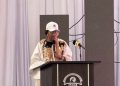
The President of the Trade Union Congress of Nigeria, TUC, Comrade Festus Osifo, has praised the Department of State Services, DSS, for what he described as its intensified crackdown on terrorists and bandits, saying the ongoing arrests and prosecutions are a strong deterrent to criminal networks operating across the country.
Speaking in Abuja on Tuesday, Osifo said the Service’s recent efforts were sending an unambiguous message to violent actors who have for years terrorised communities in the North-West, North-East, North-Central and, increasingly, parts of the South.
“When they are arrested and prosecuted, the bad guys get the clear message,” he said.
The TUC President aligned himself with the position canvassed by the DSS leadership that terrorists and bandits whose actions result in the loss of human lives should face the death penalty, arguing that such a sanction would deter others toying with the idea of taking up arms.
“When that is done, the other bad guys will know it is no longer business as usual,” Osifo said.
He urged the Service to sustain the momentum, stressing that organised labour and civil society had a duty to hold government accountable on both its failings and its gains.
“When government does wrong things, we condemn them. When they do positive things, we are also duty bound to commend,” he added.
Also Read:TUC slams 65% electricity tariff hike
Osifo also commended the DSS Director-General, Oluwatosin Adeola Ajayi, for what he described as far-reaching internal reforms in the Service, and challenged him to do more in confronting the country’s multi-layered security challenges.
Nigeria’s Long Road on Terror Prosecutions
Osifo’s remarks come against the backdrop of more than a decade of struggle by security agencies to move beyond arrests and battlefield operations to secure convictions against terrorism suspects in court.
Since the escalation of the Boko Haram insurgency in the North-East from 2009, and the emergence of its splinter, the Islamic State West Africa Province, ISWAP, Nigerian security agencies — including the military, the police, the DSS and the Nigeria Financial Intelligence Unit — have detained thousands of suspects. For years, however, actual prosecutions lagged far behind arrests, with detainees held in facilities such as the Kainji and Giwa Barracks for extended periods without trial.
To clear the backlog, the Federal Government, working with the Office of the Attorney-General of the Federation, launched a series of mass civilian terrorism trials from 2017 at a purpose-built complex in Kainji, Niger State, and later at Kuje in the Federal Capital Territory.
Successive phases of those trials — conducted under the Terrorism (Prevention) Act 2011, as amended in 2013 and further strengthened by the Terrorism (Prevention and Prohibition) Act 2022 — have produced hundreds of convictions for offences ranging from membership of a proscribed organisation and financing of terrorism to direct participation in attacks.
Many others have been discharged for lack of evidence or enrolled in the government’s deradicalisation and reintegration programme, Operation Safe Corridor.
The prosecution front has since widened beyond the North-East. With the spread of banditry and mass abductions across Zamfara, Katsina, Kaduna, Sokoto, Niger and parts of the North-Central, the Federal Government in 2022 formally proscribed bandit groups as terrorists, bringing kidnappers-for-ransom and rural marauders under the same legal regime as Boko Haram and ISWAP.
That designation opened the door to the freezing of assets, prosecution of informants and financiers, and, in principle, capital punishment for offences that result in death.
The DSS, in particular, has in recent years profiled its role in disrupting terror-financing networks, arresting high-value suspects — including alleged ISWAP commanders, bandit kingpins and their logistics handlers — and handing them over for prosecution. The Service’s leadership has repeatedly argued that visible, speedy trials, backed by the ultimate sanction of the law, are indispensable to breaking the cycle of impunity that has emboldened armed groups.
Human rights organisations, including Amnesty International and the Nigerian Bar Association, have at various times raised concerns about prolonged pre-trial detention, the transparency of mass trials and the humane treatment of suspects. Government officials, on their part, insist the trials meet due-process standards and are conducted by regular federal judges.
It is against this layered history — of insurgency, mass detentions, phased trials and evolving anti-terror legislation — that Osifo’s endorsement lands. By publicly backing tougher sanctions, including the death penalty for terrorists and bandits who kill, the TUC is lending organised labour’s voice to a hardening national mood that increasingly views prosecution, not just military operations, as central to restoring security across Nigeria.
Crediblenewsng.com