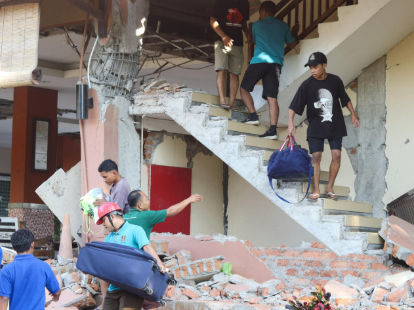
Thousands of people displaced by a powerful earthquake in eastern Indonesia are sheltering in makeshift camps as they await aid, two days after the 7.7-magnitude tremor killed 54 people and injured more than 100.
The number of residents unable to return home on Flores island rose to 12,800 by Monday morning, with many spending a third night outdoors after more than 1,600 aftershocks rattled the area, according to Badan Nasional Penanggulangan Bencana, BNPB, the official National Disaster Management Agency.
Berton Suar Pelita Panjaitan, spokesman for Indonesia’s BNPB said that the displaced residents were spread across several towns on Flores.
In the town of Mbay, in Nagekeo regency near the epicentre, residents have erected makeshift tents using tarpaulins and poles as they remain afraid to return to damaged homes.
“Our houses are no longer liveable, because many have collapsed and are full of cracks, so we can’t go inside anymore,” said Junaidin, 32, a Mbay resident, who was staying in a tent with about 30 other people. “We only go back home to get water, clothes, pillows, and then we spend the nights here.”
The shallow earthquake struck early Saturday off the northern coast of Flores. At least 914 houses were severely damaged, while hundreds of others sustained lighter damage, according to the disaster agency. Dozens of public buildings, including schools, health facilities and government offices, were also affected.
The disaster has revived traumatic memories among residents of a 7.7-magnitude earthquake that struck Flores in 1992, triggering a tsunami that killed about 2,500 people.
“We’re on our own here,” Junaidin said, expressing frustration over what he described as delays in the arrival of government assistance as Indonesia marked its Independence Day with celebrations in the capital, Jakarta.
Also Read: Powerful earthquake kills 111 in Columbia
“As for help from the government, there hasn’t been any — no tents, no medicine, no food, no drinking water, nothing,” he said. “Please open your eyes, government. We are your people, we are part of you. So please look after us.”
The Indonesian Air Force said it was transporting 13 tonnes of emergency supplies aboard two Hercules aircraft and a Boeing aircraft. Helicopters were also being deployed to deliver aid directly to survivors in isolated communities, the state-run Antara news agency reported, citing the commander of El Tari Air Base in Kupang.
The supplies include food, clothing, clean water and emergency medical equipment, while military personnel have been deployed to assist with distribution at key locations. For many residents, the assistance cannot come soon enough.
“We fled with nothing. Just the clothes on our backs. We’re victims; we’re going through a disaster,” said Siti Saudah Daso, 31, a mother of three from Mbay. “They said they would give us something, but there’s no proof. So honestly, we’re a bit upset, disappointed.”
Rescuers were continuing to search the affected areas for possible victims, search and rescue official Fathur Rahman said.
“We conduct land and air operations from helicopters. There haven’t been any reports of missing persons, but we are still scouring the area just to be sure,” he said.
The affected areas have few, if any, high-rise buildings, potentially limiting the risk of large-scale building collapses.
Save the Children said more than 8,000 children were facing “safety risks and disruptions to their education” following the earthquake.
Indonesia is particularly prone to earthquakes because it lies along the Pacific “Ring of Fire”, an arc of intense seismic activity stretching from Japan through Southeast Asia and across the Pacific basin
PUNCH