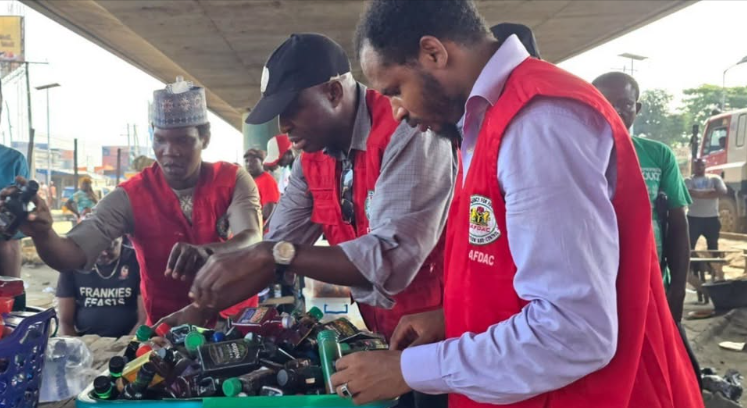
The National Agency for Food and Drug Administration and Control, NAFDAC, has ordered manufacturers of alcoholic beverages packaged in sachets and PET bottles below 200ml to commence a nationwide recall and halt further production of the banned products.
The Director-General of NAFDAC, Prof. Mojisola Adeyeye, gave the directive at a news conference in Lagos on Monday while briefing journalists on the agency’s ongoing enforcement against the production and sale of prohibited alcoholic beverages.
Adeyeye said the directive was part of NAFDAC’s renewed nationwide enforcement operations aimed at ensuring full compliance with the Federal Government’s ban on alcoholic drinks packaged in sachets and small PET bottles.
The News Agency of Nigeria recalls that NAFDAC announced the nationwide ban in January, following the Federal Government’s prohibition of alcoholic beverages packaged in sachets and PET bottles below 200ml.
According to Adeyeye, NAFDAC had commenced a second tier of nationwide pop-up operations, during which banned package sizes were discovered at distribution centres.
She said the enforcement activities had resulted in the closure of factories found to have violated the agency’s directives.
Adeyeye explained that the Distillers and Blenders Association of Nigeria, DIBAN, and the Association of Food, Beverage and Tobacco Employers, AFBTE, were required to sign irrevocable enforcement undertakings on behalf of their members.
She said the undertakings were intended to ensure that manufacturers were formally informed of the need to stop producing alcoholic beverages in the prohibited package sizes before their facilities could be reopened.
The NAFDAC boss added that the agency had imposed investigative charges on companies found to have violated regulatory directives relating to the manufacture and distribution of banned alcoholic beverages.
She said affected companies would be required to settle applicable charges within the stipulated period and comply fully with all regulatory requirements.
Adeyeye said all products recalled under the enforcement exercise would undergo inventory verification before being destroyed under NAFDAC’s supervision.
She further disclosed that facilities involved in the production of prohibited alcoholic beverages would not be allowed to reopen until they provided evidence that the relevant production lines had been permanently disabled or reconfigured.
Also Read: NAFDAC cracks down on unsafe health supplements
“The dismantling or reconfiguration of the production lines shall be carried out under the direct supervision and verification of NAFDAC officers,” she said.
Adeyeye stressed that the reopening and continued operation of affected facilities would depend on full compliance with the nationwide recall directive.
She warned that companies that failed to comply could face severe sanctions, including continued closure, placement on NAFDAC’s Regulatory Watchlist, suspension or revocation of product registrations and prosecution.
Adeyeye said the ban was not an abrupt decision but the result of several years of consultations involving regulators, manufacturers and relevant government agencies.
She recalled that NAFDAC raised concerns in 2018 over the widespread availability of high-alcohol-content drinks packaged in sachets and small bottles.
According to her, regulators were concerned that such products were cheap, easy to conceal and readily accessible to minors.
She said discussions subsequently involved NAFDAC, the Ministry of Health, the Federal Competition and Consumer Protection Commission, DIBAN and AFBTE.
Adeyeye explained that manufacturers were initially given a five-year moratorium after they argued that an immediate ban could result in job losses, factory closures and financial losses.
“A memorandum of understanding was signed in December 2018. The agreement provided a five-year moratorium for manufacturers to gradually phase out alcohol in sachets and small-volume containers,” she said.
She added that the industry was given until Jan. 31, 2024, to reconfigure production lines, move to larger packaging formats and completely phase out sachet alcohol and small bottles.
Adeyeye said the main objective of the ban was to reduce underage drinking, alcohol abuse and easy access to highly concentrated alcoholic beverages.
She said enforcement of the ban was also supported by independent research highlighting the extent to which minors and underage persons could access alcohol in small packages.
According to the research, 47.2 per cent of minors and 48.8 per cent of underaged persons procured alcoholic drinks in sachets, while 41.2 per cent of minors and 47.2 per cent of underaged persons procured drinks in PET bottles.
The NAFDAC director-general said the findings reinforced the need for stronger enforcement of regulations governing the production and sale of alcoholic beverages.
She reaffirmed the agency’s commitment to protecting public health and reducing harmful alcohol consumption, particularly among children and young people.
Adeyeye said NAFDAC would continue engaging industry stakeholders while maintaining strict enforcement of regulatory directives designed to protect the health and wellbeing of Nigerians.
NAN