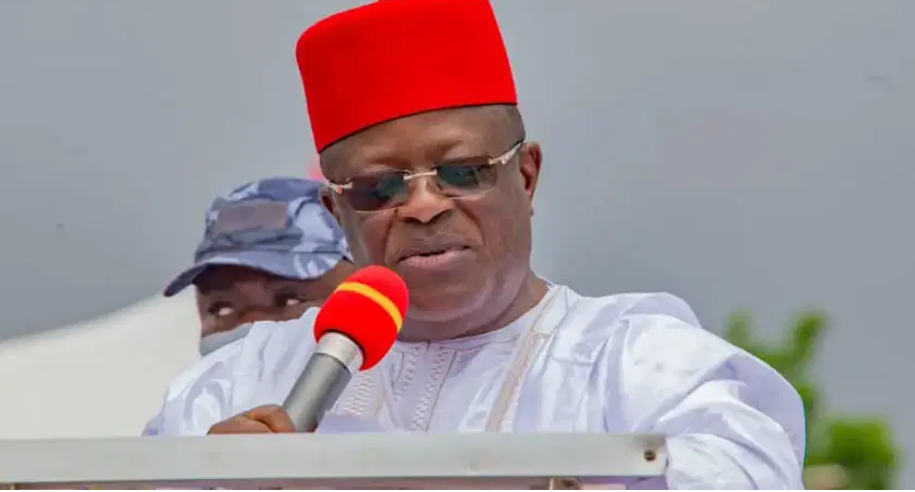
The Minister of Works, David Umahi, has apologized to commuters and residents of Edo and Delta states over the poor condition of the Benin-Sapele Road, which has caused significant hardship for road users.
Umahi also ordered the arrest of the contractor and concessionaire handling the project, as well as any other persons found removing asphalt from federal roads without proper authorization.
The minister issued the apology and directive in Benin during an inspection of major road projects across Edo State. He commended Edo youths and residents for remaining calm despite the difficulties caused by the condition of the road, saying their restraint had helped prevent a possible breakdown of law and order.
Umahi expressed dissatisfaction with the performance of the concessionaire handling the road, accusing the company of lacking the technical capacity required to execute the project effectively.
The minister said he personally witnessed the removal of asphalt from the road during an earlier inspection with the Edo State Governor, Monday Okpebholo, and directed the contractor to discontinue the practice.
According to him, the Ministry of Works does not authorize contractors to remove asphalt from federal roads without approval, describing the practice as a form of “destruction of public infrastructure.”
Umahi consequently directed all ministry controllers to arrest contractors or concessionaires found removing asphalt from federal roads without the necessary approval.
He further criticized the concessionaire’s approach to the project, saying its alleged lack of technical competence had contributed to the hardship experienced by commuters and residents.
The minister stressed that the Federal Government must ensure that companies awarded road projects possess the technical expertise and capacity required to deliver them.
He also questioned the competence and integrity of the concessionaire before it took over the construction of the Benin-Agbor Road.
Also Read: FG prepares to fix Benin-Asaba road, rebuild Carter bridge
Umahi said President Bola Tinubu was aware of the difficulties faced by road users and had directed the Ministry of Works to take immediate steps to restore the road and reduce the suffering of affected communities.
He explained that although concession agreements were governed by existing laws, the government could rely on overriding public interest when necessary to protect citizens and critical infrastructure.
The minister again apologized to commuters, residents of Edo and Delta states and other road users affected by the poor condition of the road.
He assured them that rehabilitation work would commence immediately to provide relief, in line with the President’s directive.
Umahi added that the Federal Government would continue to prioritize the safety and welfare of Nigerians affected by the condition of major federal roads.
He also commended Governor Okpebholo for his commitment to infrastructure development and his efforts to support the rehabilitation of federal roads across Edo State.
Responding, Okpebholo appealed to residents and youths in communities affected by the road’s condition to remain patient and maintain peace while efforts to restore the road continued.
The governor recalled the previously poor condition of the Benin-Ekpoma Road, saying President Tinubu had promised to reconstruct it following a meeting between them and had subsequently fulfilled the commitment.
Okpebholo noted that Edo’s strategic location makes it an important gateway connecting several parts of the country, warning that prolonged unrest in the state could have wider consequences for Nigeria.
Meanwhile, the Chief Executive Officer of the concessionaire, Samuel Daramola, attributed the slow pace of construction to heavy rainfall.
Daramola said the company had resorted to palliative repairs to keep traffic moving while work on the road continued.
He explained that one of the company’s first actions after taking over the Benin-Agbor Road was to expand sections of the road.
According to him, the concessionaire initially focused on palliative works because of the numerous potholes that had made movement difficult for commuters.
He said the temporary interventions were intended to improve access and ease traffic while more extensive construction work progresses.
NAN