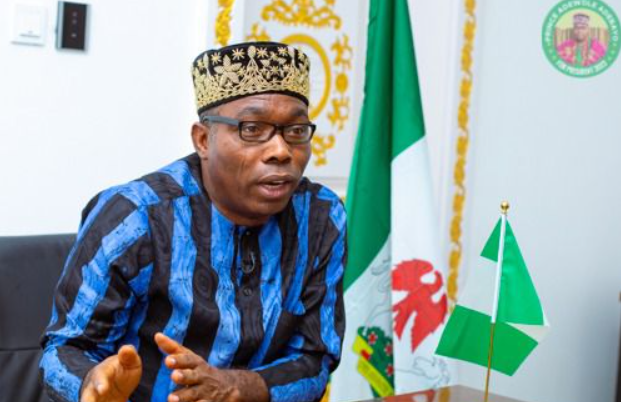
The Social Democratic Party, SDP, presidential candidate, Prince Adewole Adebayo, has unveiled a policy blueprint aimed at addressing Nigeria’s economic and security challenges through institutional reforms and ideas-based governance.
Adebayo presented the Presidential Blueprint, titled “Farewell to Poverty and Insecurity,” in Abuja, outlining measures focused on human development, economic productivity, energy generation, infrastructure and employment ahead of the 2027 presidential election.
He said Nigeria’s challenges were largely the result of past leadership failures rather than natural limitations, arguing that a focused administration could deliver significant structural reforms within a four-year term.
Adebayo likened the period to the time required to complete a university degree, stressing that effective leadership and sustained implementation could produce tangible results within the period.
The News Agency of Nigeria reports that the blueprint proposes generating 75,000 megawatts of electricity, establishing four functional public refineries and 36 modular refineries, as well as stabilizing the national currency through increased productivity and employment.
Adebayo described the blueprint as an invitation to move away from politics driven by ethnicity and tribalism towards a system centred on accountability, competence and sustainable leadership. He urged Nigerians to study the policy document and assess its proposals ahead of the 2027 polls.
Reinforcing Adebayo’s position, the party’s National Chairman, Prof. Sadiq Gombe, said governance must go beyond administration to focus on practical solutions to the country’s problems.
“Without security, there can be no meaningful production; without production, there can be no sustainable prosperity,” Gombe said, outlining the party’s governance philosophy.
Also Read: Adebayo promises 75,000mw power from 2027
He said the framework placed emphasis on execution and strict oversight through performance contracts, regular public monitoring and accountability mechanisms.
“What our people are now demanding is delivery. They want to know what government has promised, what government has done, what remains outstanding and who is responsible,” he said.
Also speaking, the party’s Vice-Presidential Candidate, Dr Usman Bugaje, said Nigerian professionals had continued to excel globally, but the country lagged behind its regional peers in critical development indicators, particularly energy production.
Bugaje said Nigeria’s population was projected to reach about 400 million within the next 25 years, making proactive leadership necessary to position the country for a leading role in the global economy.
On agriculture, he identified what he described as significant structural inefficiencies in Nigeria’s productivity compared with international standards.
“Nigeria’s productivity is still between five and six metric tonnes per hectare,” he said, contrasting the figure with an African average of about 20 metric tonnes and citing Rwanda’s post-genocide recovery as an example of rapid agricultural transformation.
Bugaje said the blueprint proposed actionable measures, particularly to reduce energy costs, which he identified as a major driver of expenses in transportation and agriculture and a critical factor in national productivity.
While acknowledging that entrenched political interests could resist structural reforms, he said the party was prepared to confront systemic corruption and implement its proposed policies.
“We are not underestimating the difficulties that are going to be there,” Bugaje said, assuring that the party would “fight, win and deliver.”
NAN