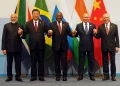
India says the development outcomes of its 2026 BRICS chairmanship align closely with the priorities of countries across Africa, Asia and the wider Global South.
Shri Sudhakar Dalela, Secretary of Economic Relations at India’s Ministry of External Affairs disclosed this at a special press briefing on the outcomes of the 18th BRICS Summit in New Delhi.
Dalela said India secured more than 50 practical outcomes across four priority pillars — resilience, innovation, cooperation and sustainability — with emphasis on practical, development-oriented and people-centred initiatives.
“If you look at the New Delhi Declaration, you will find that the attempt is to really frame collaboration on the development agenda,” he said, noting that the agenda was resonating particularly with India’s partners in Africa, Asia and other countries of the Global South.
He said India organised more than 350 meetings, both physical and virtual, spanning thematic clusters, ministerial sessions, working groups, business engagements and people-focused activities during its chairmanship.
On resilience, the official said the initiatives targeted food and health security, including the BRICS Centre for Excellence in Agroecology, the BRICS Network on Physical Agriculture and the BRICS Mission for Healthy Lifestyle, alongside cooperation on mental wellness and disaster risk reduction.
Also Read: BRICS aims at digital agriculture to boost farmers’ income
Under innovation, he said member countries advanced collaboration in science, research, technology and entrepreneurship through the BRICS Science and Research Repository, a Startup Innovation Fund and an Incubator Network.
He said the cooperation pillar produced the BRICS MSME Cooperation Portal, work on global value chains and a BRICS Logistics Supply Chain Cooperation Framework, while the sustainability pillar covered smart grids, energy storage, climate-resilient urban infrastructure, sustainable urban mobility and climate-resilient agriculture.
Dalela described the diversity of BRICS members as a strength, saying it enabled countries with different development experiences to exchange knowledge and forge consensus across the grouping’s three areas of cooperation: political and security; economic and financial; and people-to-people collaboration.
“The true measure of a chairmanship is not simply the number of meetings that are held. It is the quality of participation, the ability to build consensus and the outcomes that are created,” he said.
He added that the New Delhi Declaration and the more than 50 practical outcomes provided a strong foundation for the next phase of BRICS cooperation with partners across the Global South.
The News Agency of Nigeria reports that BRICS, a bloc of major emerging economies, originally comprised Brazil, Russia, India, China and South Africa. It has since expanded to 11 full members, adding Iran, Egypt, Ethiopia, the United Arab Emirates, Saudi Arabia and Indonesia.
NAN