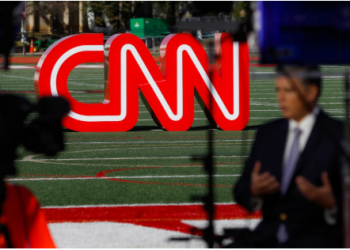
The White House has removed CNN from its scheduled Monday assignment as the television pool representative for the White House press corps, breaking with decades of established practice amid an escalating dispute between President Donald Trump’s administration and several news organizations.
CNN’s exclusion follows Trump’s announcement on Friday that he was “banning” CNN, MS NOW and Politico from the White House.
Reporters from the three outlets were denied access to the White House complex on Saturday as the organizations prepare a First Amendment lawsuit challenging the restrictions.
CNN was scheduled to serve as the primary television pool network on Monday and accompany Trump to New York for the annual United Nations General Assembly this week.
However, an email circulated by the White House on Sunday night did not identify a primary television pool network for Monday.
Hearst, which owns television stations across the United States, was listed as the secondary television crew in Washington, while Real America’s Voice, a pro-Trump network, was designated as the secondary crew for the New York trip.
The secondary television crew typically participates in the press pool and asks questions during presidential question-and-answer sessions but does not perform the full responsibilities of the primary pool network.
Trump reiterated the restrictions early Monday in a post on Truth Social, writing, “Trump bans CNN, MSNOW, and Politico from White House,” alongside a news article about the development.
Under a long-standing arrangement, ABC, CBS, CNN, NBC and Fox News share responsibility for the television press pool.
Also Read: CNN, Politico slam Trump’s media onslaught
The networks take turns filming the president and distributing live footage to one another and other news organizations.
The shared pool system allows local television stations, newspaper websites and media outlets worldwide to access presidential coverage, particularly when limited space or security restrictions prevent every organization from deploying its own crew.
CNN’s removal has raised questions about how the other four major television networks will respond, with some media critics calling for public solidarity among the broadcasters.
The exclusion also creates uncertainty over coverage of Trump’s upcoming trip to New York, where the president is scheduled to attend the United Nations General Assembly.
For each pool assignment, the designated network provides a camera operator, an audio technician and a producer or reporter.
While the technical crew records the president, the producer or reporter coordinates the live feed by telephone, takes notes and asks questions during presidential engagements.
The arrangement, which has remained largely unchanged for decades, enables one television crew to provide coverage for multiple news organizations when access or space is limited. CNN’s removal therefore has implications for the wider press corps beyond the network itself.
Presidential travel coverage is also expensive, with multi-day trips costing participating news organizations tens of thousands of dollars.
In a statement issued on Saturday, CNN said it would continue reporting on the US government despite efforts to restrict its physical access to the White House and other government buildings.
“CNN’s mission to report on the U.S. government will continue regardless of any attempts to restrict physical access to the White House and other government buildings, or any other attempts to impede our journalism,” the network said.
“We have a right under the U.S. Constitution to do our reporting without hindrance or interference from the government and this ban is an illegal assault on this fundamental right,” CNN added.
CNN