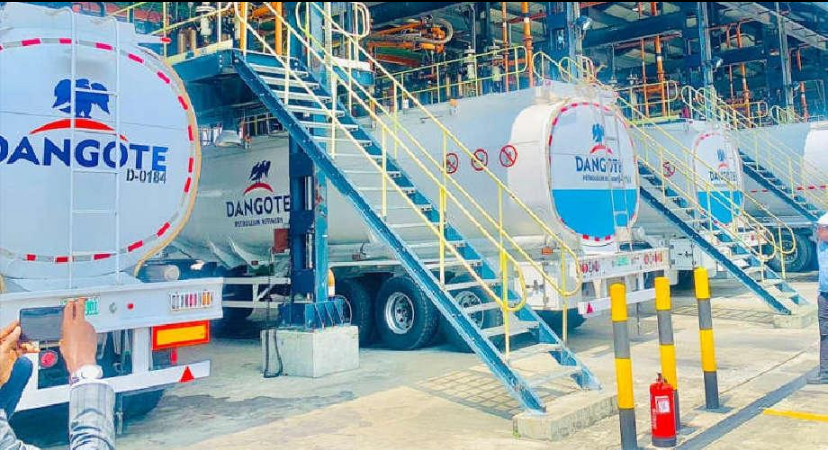
Petrol receipts rose 11 per cent in August as refinery crude supply and domestic gas supply increased, while the Dangote Refinery operated above capacity.
The Nigerian Midstream and Downstream Petroleum Regulatory Authority, NMDPRA, reported the figures in its August 2026 factsheet on Nigeria’s midstream and downstream petroleum sector.
The authority recorded an average daily petrol receipt of 50.5 million litres in August, up from the previous month.
Domestic sources drove the increase, with locally supplied petrol rising by 39 per cent despite a 26 per cent decline in imported volumes.
Crude oil receipts by domestic refineries also rose by 17 per cent, from 585,000 barrels per day (bpd) in July to 683,000 bpd in August.
However, Automotive Gas Oil, commonly known as diesel, recorded a 39 per cent decline in daily receipts to 14.5 million litres.
The decline reflected lower domestic supply and imports.
Liquefied Petroleum Gas receipts also fell by 19 per cent, despite a 44 per cent increase in imports.
Aviation Turbine Kerosene, commonly known as aviation fuel, recorded a 63 per cent increase in daily receipts to 3.1 million litres.
Petrol consumption declined by 14 per cent to 41.5 million litres per day, based on volumes trucked into the domestic market, while diesel consumption fell by 15 per cent.
Aviation fuel consumption, however, rose by 22 per cent.
The sector also recorded stronger stock levels, with petrol sufficiency reaching 22.9 days and diesel sufficiency 51.6 days as of Aug. 31.
Domestic gas supply, including volumes delivered to the Nigeria LNG Ltd. increased by four per cent to 4.930 billion cubic feet per day (bcf/d).
The Dangote Refinery recorded the highest performance among domestic refineries, operating at an average 105.21 per cent of its rated capacity during the month.
The refinery received 137.98 million barrels of crude oil in August, comprising 109.88 million barrels from domestic sources and 28.10 million barrels from imports.
Also Read: Court stop NMDPRA from shutting down Dangote refinery
It produced an average of 41.94 million litres of petrol, 18.01 million litres of diesel and 24.48 million litres of aviation fuel daily.
As of Aug. 31, the refinery held closing stocks of 360.4 million litres of petrol, 137.2 million litres of diesel and 133.3 million litres of aviation fuel.
None of the three state-owned refineries in Port Harcourt, Warri and Kaduna recorded production during the month.
Among modular refineries, Edo Refinery recorded 90.43 per cent capacity utilisation, followed by Walter Smith Refinery at 64.77 per cent and Aradel Refinery at 58.77 per cent.
OPAC Refinery operated at 16.97 per cent capacity, while Duport Refinery remained shut.
Gas utilisation also increased across the power, commercial and industrial sectors.
However, liquefied natural gas exports through NLNG declined to 105,317 cubic metres per day, while exports through the West African Gas Pipeline rose to 0.152 bcf/d.
Plant condensate production stood at 14.817 million barrels between January and August, averaging 1.852 million barrels monthly.
June recorded the highest monthly output at 2.220 million barrels.
The NMDPRA also reported progress on major gas infrastructure projects.
The Obiafu-Obrikom-Oben (OB3) River Niger Crossing reached completion, while the wider OB3 Gas Pipeline project stood at 96 per cent completion.
The East-West Gas Pipeline System Midline Compressor project reached 96.37 per cent completion.
The Ajaokuta-Kaduna-Kano Gas Pipeline stood at 80 per cent completion, while the Obidi-Warri Expansion project reached 71.17 per cent.
The Escravos-Obidi Gas Pipeline stood at 27.50 per cent completion.
The figures highlight increased domestic refinery activity and gas supply during the month, alongside mixed trends in petroleum product receipts and consumption.
NAN