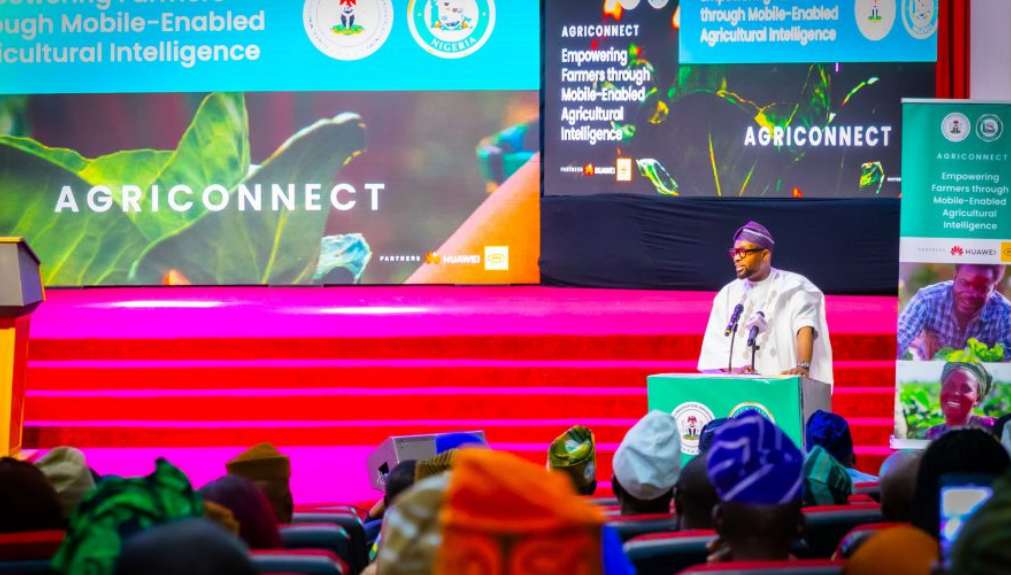
The International Institute of Tropical Agriculture, IITA, on Friday launched the Nigeria AgriConnect Compact, a World Bank-funded initiative aimed at transforming Nigeria into a leading regional food basket and creating 2.56 million jobs by 2030.
The initiative seeks to coordinate agricultural investments, boost productivity, expand processing, improve market access and attract private-sector investment across key value chains, including rice, maize and cassava. It is designed to align existing projects and guide new investments over the next five years.
The News Agency of Nigeria reports that the compact is also expected to strengthen smallholder farmers’ access to finance, improve agricultural policies and support the development of value chains covering staple crops, cash crops and livestock.
The Minister of Agriculture and Food Security, Abubakar Kyari, said Nigeria was not suffering from a shortage of agricultural programmes, projects or investments.
Kyari said substantial resources were already being committed to irrigation, roads, imports, localization, livestock, finance, land restoration, processing and market access across the country.
“The greater challenge is ensuring that these investments reinforce one another. Agriculture is a system, and when one part of that system is disconnected, the value of the investment elsewhere is diminished.
“The Nigeria AgriConnect Compact gives us a practical framework for doing precisely that. It aligns investments already underway and guides those that come next in line to share national outcomes.
“Its purpose is not to assemble projects under one name, but to make deliberate connections between them, close the gaps between interventions, and ensure that public resources, development finance and private capital produce greater results together,” he said.
The Governor of Oyo State, Seyi Makinde, identified affordable food, productive jobs, stronger rural economies and competitive businesses as priorities for translating Nigeria’s agricultural potential into economic gains.
Makinde said Nigeria was not lacking in agricultural activity, noting the presence of farmers, research institutions, young innovators, fertile land and a large domestic market.
Also Read: Tinubu unveils $7bn investment package for Ogun seaport
“We have hardworking farmers, respected research institutions, and within perhaps a 15-to-20-kilometre radius of here, at least six or seven research institutes.
“We also have innovative young people, fertile land and a large domestic market. Yet, many farmers remain poor, food remains expensive, and too much of what we produce is lost before it reaches consumers. This basically tells us that production alone is not enough.
“Agriculture must be treated as a complete economic system. Production must connect to security, research, extension services, finance, rural roads, storage, processing, standards, logistics and markets.
“If one part of that chain fails, the farmer earns less, the processor operates below capacity, and the consumer pays more.
“This is the solution that AgriConnect is about to bring to the table. Its value will not lie in creating another layer of programmes.
“The value of AgriConnect will lie in bringing government, research institutions, finance providers, development partners, farmers and private enterprises together around a common delivery plan,” he said.
The Nigeria AgriConnect Compact provides a framework for coordinating existing projects and guiding pipeline development over the next five years in line with sector development priorities.
The initiative seeks to increase smallholder farmers’ productivity, modernize agricultural policies to attract greater private investment and establish a financial system that improves access to credit for smallholder farmers and agribusinesses.
Within the next five to 10 years, the compact aims to strengthen coordination and improve funding for projects focused on food and nutrition for nearly three million people.
It also targets the creation of about 2.5 million new and better jobs by strengthening agricultural value chains and helping smallholder farmers improve productivity and access to markets. The value-chain development efforts are expected to focus on staple crops, cash crops and livestock.
NAN