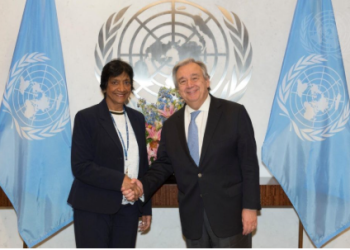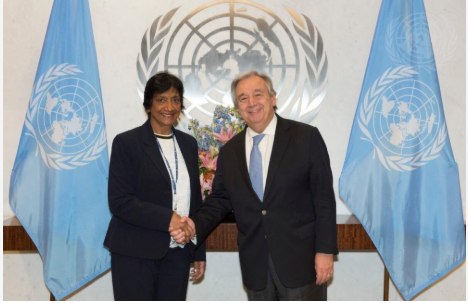
UN Secretary-General António Guterres has hailed the award of the 2026 Nobel Peace Prize to former UN human rights chief Navi Pillay, describing her as a courageous defender of justice.
Guterres said Pillay’s decades of service demonstrated that international law and human rights must prevail over oppression, injustice and the arbitrary exercise of power.
The UN Secretary-General’s remarks were conveyed in a congratulatory statement released on Friday by his Spokesperson, Stéphane Dujarric, at UN Headquarters in New York.
“I warmly congratulate Navanethem ‘Navi’ Pillay on being awarded the 2026 Nobel Peace Prize,” Guterres said.
He described the South African jurist as a steadfast and independent advocate of justice who had helped shape some of the most consequential international legal proceedings.
“For decades, she has been a champion of international law and human rights, and a steadfast, independent voice of justice,” he said.
Guterres reflected on Pillay’s beginnings as a lawyer in apartheid South Africa, where she represented Nelson Mandela and others who resisted entrenched racial injustice.
He noted that her unwavering dedication to fairness carried through her remarkable journey as an international judge and a prominent defender of human rights.
Pillay subsequently served as a judge and President of the International Criminal Tribunal for Rwanda, ICTR, established to prosecute those responsible for the 1994 genocide.
Guterres commended Pillay’s contributions to the tribunal’s work, including proceedings arising from atrocities committed during the Rwandan genocide.
He also highlighted her tenure as United Nations High Commissioner for Human Rights, during which she advocated stronger international protection for fundamental freedoms.
Also Read: South African judge Pillay wins 2026 Nobel Peace Prize
Pillay served as UN High Commissioner for Human Rights from 2008 to 2014, addressing human rights concerns across conflict-affected and politically divided societies.
The Secretary-General also acknowledged her leadership of the UN Independent International Commission of Inquiry on the Occupied Palestinian Territory, including East Jerusalem, and Israel.
Guterres said Pillay’s career reflected a consistent conviction that the rule of law must guide international relations and protect vulnerable populations.
He praised her demonstration that “the force of law must prevail over the law of force.”
The UN Secretary-General stressed that safeguarding human rights is one of the most effective defenses against oppression, conflict, and misuse of authority.
He further praised the Nobel Committee for underscoring the enduring values that are essential to achieving lasting peace.
“In its citation, the Nobel Committee reminded the world that peace must be built on lasting principles, not the will of the powerful,” he said.
Guterres said the recognition extended beyond Pillay’s individual achievements to everyone working to defend international law and human dignity.
“Today’s prize is a tribute to all those working to uphold and defend international law, the rule of law and human rights,” he said.
He stressed that lasting peace required accountability, justice and respect for fundamental freedoms rather than reliance on political or military power.
The Nobel Peace Prize is awarded annually to individuals or organisations recognised for outstanding contributions to peace and international cooperation.
Guterres said the award underscored the enduring importance of justice, accountability and human dignity in securing lasting international peace.
NAN