

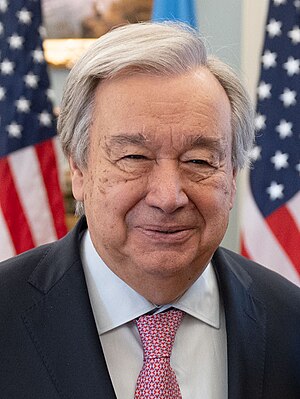
UN Secretary- General Antonio Guterres has condemned the United States’ imposition of sanctions against the International Criminal Court, ICC, as an institution, according to his spokesperson, Stéphane Dujarric.
Dujarric told journalists on Friday that Guterres criticised the decision as U.S. Secretary of State Marco Rubio vowed to “dismantle the ICC, brick by brick” unless it ends what Washington regards as a “threat” to its citizens.
He said Guterres was “deeply alarmed” by the expected impact on the court’s “continued ability to perform its important mandates”.
The UN chief, however, called the sanctions “a serious blow to our collective pursuit of international criminal justice, of which the ICC is a key pillar”.
He reiterated his “unwavering support for the independence of the court and its officials” and called on all States to uphold their commitments under international law.
The UN remains committed to cooperating with the ICC under the relationship agreement approved by the General Assembly on September 13, 2004, the statement added.
Meanwhile, the court hit back forcefully, calling the step unprecedented, following sanctions by the U.S. already in place against 13 of its judges and prosecutors.
Also Read: Let’s resist America’s blackmail, ICC chief urges Japan
The ICC described the measure as “an assault on the rule of law and on the very foundations of the international legal order”.
The sanctions, the court said, were aimed at disrupting its operations and “intimidating those who work for or cooperate with the court”.
The court, however, said, it would not be deterred.
“The court will continue to fully discharge its mandate, with independence and impartiality, acting only on the basis of the law and the evidence for the sake of the countless victims of grave crimes,” ICC President Tomoko Akane, said.
Yet, the court acknowledged that it cannot stand alone.
“Its fate now rests also in the hands of the states that created it,” the statement said, adding that the Rome Statute’s promise “is only as strong as the resolve of those who made it”.
“No one should be punished for serving the cause of justice. History will judge this moment,” it added.
Announcing the sanctions, Rubio said the U.S. would “ban transactions with this rogue court, cutting off their resources and crippling its ability to operate”.
“America never joined the court. We don’t need it. And we don’t want it,” he added.
Rubio said the door to diplomacy remained open, but he issued a stark warning. “Either the ICC will end its threats, or we will end the ICC,” he said, adding that Washington expected allies to “rein in the court”.
Independent UN human rights experts also warned that the U.S. sanctions were a “brash attempt” to dismantle a collective international legal system to hold perpetrators of the gravest crimes to account.
They called on states committed to the rule of law to stand together in defence of the court and its independence.
“Sanctioning the institution entrusted with delivering justice for the gravest international crimes is an assault on the foundations of international accountability and rule of law,” the experts said.
“No state should place itself beyond the reach of the law by intimidating the court established to enforce it and attempting to dismantle it.”
The UN Human Right Council-appointed experts – who are not employed by the UN and receive no salary for their work – added that the attack “directly injures the victims of atrocities and their advocates, who rely on the ICC for justice, accountability and reparation”.
UN Secretary-General António Guterres has hailed the award of the 2026 Nobel Peace Prize to former UN human rights chief Navi Pillay, describing her as a courageous defender of justice.
Guterres said Pillay’s decades of service demonstrated that international law and human rights must prevail over oppression, injustice and the arbitrary exercise of power.
The UN chief made the remarks in a congratulatory statement issued on Friday by his Spokesperson, Stéphane Dujarric, at UN Headquarters in New York.
“I warmly congratulate Navanethem ‘Navi’ Pillay on being awarded the 2026 Nobel Peace Prize,” Guterres said.
He described the South African jurist as a steadfast and independent advocate of justice who had helped shape some of the most consequential international legal proceedings.
“For decades, she has been a champion of international law and human rights, and a steadfast, independent voice of justice,” he said.
Guterres recalled Pillay’s early legal career in apartheid-era South Africa, where she defended Nelson Mandela and others who challenged institutionalised racial discrimination.
He said her commitment to justice continued through her distinguished career as an international judge and human rights advocate.
Pillay subsequently served as a judge and President of the International Criminal Tribunal for Rwanda (ICTR), established to prosecute those responsible for the 1994 genocide.
Guterres commended Pillay’s contributions to the tribunal’s work, including proceedings arising from atrocities committed during the Rwandan genocide.
He also highlighted her tenure as United Nations High Commissioner for Human Rights, during which she advocated stronger international protection for fundamental freedoms.
Pillay served as UN High Commissioner for Human Rights from 2008 to 2014, addressing human rights concerns across conflict-affected and politically divided societies.
The Secretary-General also acknowledged her leadership of the UN Independent International Commission of Inquiry on the Occupied Palestinian Territory, including East Jerusalem, and Israel.
Guterres said Pillay’s career reflected a consistent conviction that the rule of law must guide international relations and protect vulnerable populations.
He praised her demonstration that “the force of law must prevail over the law of force.”
The UN chief maintained that protecting human rights remained one of the strongest safeguards against injustice, conflict and the abuse of power.
He also welcomed the Nobel Committee’s emphasis on the importance of lasting principles in building sustainable peace.
“In its citation, the Nobel Committee reminded the world that peace must be built on lasting principles, not the will of the powerful,” he said.
Guterres said the recognition extended beyond Pillay’s individual achievements to everyone working to defend international law and human dignity.
“Today’s prize is a tribute to all those working to uphold and defend international law, the rule of law and human rights,” he said.
He stressed that lasting peace required accountability, justice and respect for fundamental freedoms rather than reliance on political or military power.
The Nobel Peace Prize is awarded annually to individuals or organisations recognised for outstanding contributions to peace and international cooperation.
Guterres said the award underscored the enduring importance of justice, accountability and human dignity in securing lasting international peace.











