Pope Leo XIV has been diagnosed with lung cancer after undergoing successful surgery to remove the lower lobe of his right lung at Rome’s Gemelli Hospital.
The Vatican said Pope Leo XIV’s 90-minute operation on Tuesday was successful, with no complications.
“The operation was successful and there were no complications,” the Vatican said. “After the operation, the Pope awoke normally and returned after a brief period of observation to his room.”
The pontiff had a “peaceful night” in the hospital, the Vatican said on Wednesday morning, and he is expected to remain there for about a week.
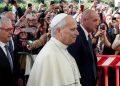
Large crowds gathered outside the hospital ahead of his arrival on Tuesday, cheering as he waved and smiled through a car window.
Hospital staff welcomed him at the entrance. When one person expressed sympathy, saying, “I’m sorry,” the Pope responded with a smile and a shrug.
The Vatican said surgeons removed the entire lower lobe of his right lung to ensure the procedure was thorough.
Pope Leo had announced the planned operation on Sunday during his weekly prayers in St Peter’s Square. He told the crowd that doctors had discovered a nodule in his lung.
He reassured pilgrims that the mass was well-contained and had been detected at an early stage, but said doctors had advised him to have it removed.
Lung nodules are common and are not always cancerous. However, after examining the growth, the medical team confirmed lung adenocarcinoma, as suspected during pre-operative tests.
A Vatican source told APP that further tests were underway to determine whether the cancer had spread.
The Vatican said the Pope had shown no symptoms of infection or illness before the diagnosis.
Cardinal Tarcisio Isao Kikuchi of Tokyo, who met the pontiff on Monday, said he had noticed nothing physically wrong with him.
The Pope’s schedule has been cleared until October 20 to allow him to recover. He reportedly wants to undergo treatment without delaying a planned trip to Latin America in early November.
The trip is particularly significant because it includes Peru, where he served as a missionary and later as a bishop for several years.
The diagnosis has caused concern among Catholics worldwide, many of whom remember Pope Francis’s hospital admissions during his final years.
Also Read: Pope calls war a ‘painful defeat’ at Spanish parliament
Outside Gemelli Hospital, which has treated several popes, some Catholics remained nearby after Leo was admitted, hoping to offer their support and prayers.
“He seems calm, so we are calm too, even though illness is always unpleasant,” a woman identified as Carla told the BBC. “We will wait here and pray.”
Another Catholic, Elsa, said she was deeply affected when the Pope announced his operation in St Peter’s Square. She had expected him to be younger and healthier and said the news had taken her by surprise.
Elise Ann Allen, who wrote a biography of the Pope, urged the public to wait for further medical information before drawing conclusions about his condition.
Speaking to the BBC’s Newsday programme, she said it was too early to determine the severity of the situation or conclude that everything was fine.
The Pope’s brother, Louis Prevost, has also been receiving treatment for multiple myeloma, a type of blood cancer distinct from lung adenocarcinoma.
In Chiclayo, a city in northern Peru where Leo served as bishop for eight years, residents have been praying for his recovery ahead of his planned visit.
The city is expected to be a significant stop on his Latin American tour. Officials had announced shortly before the Pope disclosed his operation that they expected about 1.5 million people to travel there for his visit.
“God willing, we will have him here, because these preparations have been going on for several months, not just on a practical level, but also on a spiritual one,” a retired journalist told APP.
Archbishop Richard Moth, the head of the Catholic Church in England and Wales, expressed gratitude and relief that the Pope’s surgery had been successful.
Lung adenocarcinoma develops in cells that produce mucus and is one of the most common forms of lung cancer.
The long-term outlook depends on several factors, including the stage at which the cancer is diagnosed and the patient’s overall health. Early detection generally improves treatment prospects, and treatment options have advanced over recent decades.
Some cases are detected before symptoms develop during routine examinations. In more advanced stages, lung cancer can cause a persistent cough, breathlessness, fatigue and weight loss.
BBC News