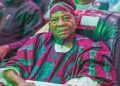
Pa Reuben Famuyide Fasoranti died on Tuesday in Akure, aged 100, Ondo State Governor Lucky Aiyedatiwa said in a statement he signed personally.
The Afenifere leader marked his centenary only five months earlier, on 11 May.
He taught English and geography, balanced a state’s books, survived an assassin’s bullet and buried a daughter shot dead on the road home. For seven decades he was the conscience Yorubaland kept on call.
The first thing to say about Reuben Famuyide Fasoranti is that he was a teacher before he was anything else — and he never really stopped being one.
He was born on 11 May 1926 in Uso, in today’s Owo Local Government Area of Ondo State, into a colonial Nigeria that had not yet imagined independence.
He went to Ondo Boys’ High School, then Yaba Higher College in Lagos, then University College, Ibadan, where he took a degree in English and Geography. Later came a postgraduate diploma in education at the University of Hull and a master’s in school administration in Sydney — a voyage he once recalled, in the flat way of his generation, as “excruciating.”
Also Read: Sanwo-Olu congratulates centenarian Afenifere leader
He came home and taught at the school that had made him. Then he ran schools: principal at Oyemekun Grammar School, at Iju-Itaogbolu Grammar School, at Christ School, Ado-Ekiti. Then, when salaried service was done, he built his own — Omolere Nursery and Primary School, Akure High School, and St Frances Academy at Igoba, which he founded in memory of his wife, who died in 1991.
That last detail tells you most of what you need to know about the man. He did not build a mausoleum. He built a school.
The finance man Awolowo would not spare
Politics came early, at Ibadan, through the Action Group students’ association. He stayed loyal to the Awolowo tradition through its ruptures — AG in the First Republic, the Unity Party of Nigeria in the Second — and it was as UPN Commissioner for Finance in old Ondo State, under Chief Adekunle Ajasin between 1979 and 1983, that he did his most consequential public work.
Ajasin wanted him as his running mate in 1979; Awolowo, weighing ethnic arithmetic, gave the slot to Akin Omoboriowo instead. Ajasin put the disappointment in his memoirs without decoration: he had wanted “the best person that I trusted and could work with.” Denied the deputy’s chair, Fasoranti took the treasury and balanced it — a reputation for financial prudence that has outlived every government he served.
The Second Republic ended the way it did, and the gentleman teacher was detained and tried over an alleged plot against political opponents. The charge was a lie and the trial collapsed. Under General Sani Abacha, in 1996, the state came for him again, this time with gunmen. He survived the assassination attempt and did not lower his voice.
A divided house, and the daughter he could not protect
He inherited Afenifere at its lowest ebb. When the organisation fractured after Pa Abraham Adesanya’s death, Fasoranti emerged as the leader the larger body of Yoruba opinion recognised — a custodian rather than a conqueror, presiding over a movement whose chieftains quarrelled more easily than they agreed.
The Akure Declaration, the split with the Akande–Fasanmi wing, the bitter jostling at Adesanya’s graveside: he lived through all of it, and it cost the Yoruba the single mouthpiece they had once spoken with.
In time he stepped back from the organisation he had led, citing old age, the disloyalty of men he had trusted, and a drift from the vision of the founders — Awolowo, Ajasin, Bola Ige, Onasanya, Alayande. It was not a resignation so much as a verdict.
Then came July 2019. His daughter, Funke Olakunrin, was shot dead on the Ondo–Ore road, hours after leaving his house on her way to Lagos. She was 58. He was 93. Three men were sentenced to death for the killing in June 2022; no sentence returns a daughter.
Grief did not soften him into silence, and it did not curdle him into bitterness. He kept receiving visitors in Akure, kept praying over the politicians who came for his blessing, kept being photographed in his cap and his plain robes, looking like what he was: the last of a species.
What the century leaves behind
The tributes have begun to arrive. Governor Aiyedatiwa called him “a patriarch, a beacon of wisdom, integrity and selfless service whose century-long life was marked by uncommon commitment to the development of our dear State, Yorubaland and Nigeria at large.” President Bola Tinubu, in May, marked the hundredth birthday by calling him “our father, elder statesman, administrator, pro-democracy activist, prominent politician, and foremost Afenifere leader,” and adding: “His life is a metaphor for integrity, honesty, dedicated service to the nation and true leadership.”
Perhaps the more telling tribute came from outside his faith and his ethnic home. The Sultan of Sokoto, Muhammadu Sa’ad Abubakar, the spiritual head of Nigeria’s Muslims, described a Yoruba Christian elder as “a pride of Nigeria and a national asset.”
That is the thing about Fasoranti that Nigerian politics keeps failing to learn: his authority never came from office. He was never president, never governor, never a billionaire godfather. He was a schoolmaster with a Spartan streak, an OFR, a man who would not take money to bend a principle, and who therefore could not be bought off the moral high ground.
In a country that rewards noise, he was quiet. In a country that forgets, he remembered — the colonial classroom, the independence dawn, the coups, the June 12 barricades, the return of democracy, and the long disillusionment after it.
He is survived by his children and by a state that will now have to govern without the man it used to consult.
The register he kept for a hundred years has been closed. Somewhere in Akure, a bell is ringing for assembly, and the pupils of Omolere and Akure High and St Frances are filing in without him.
Crediblenewsng.com