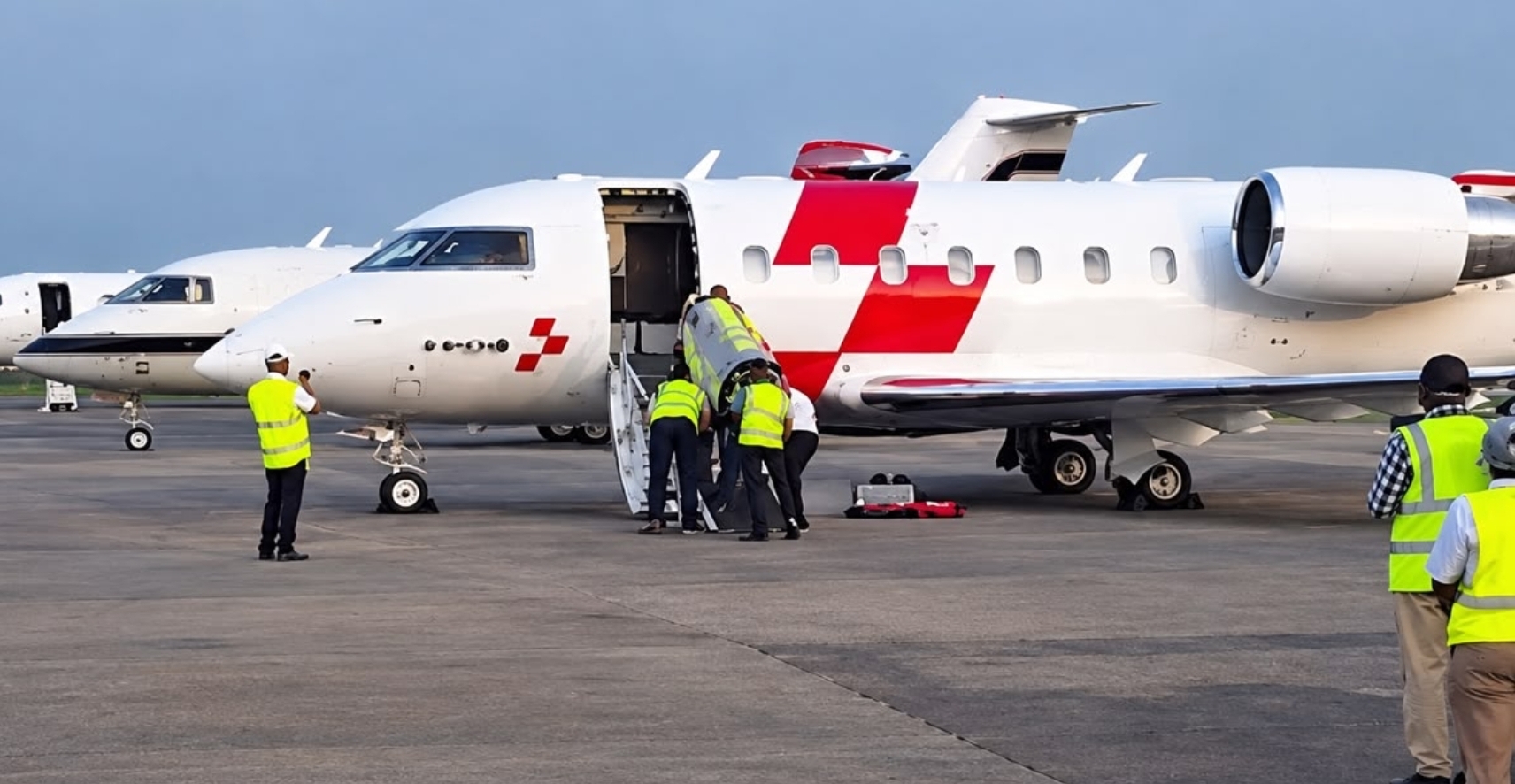
Nigeria’s first confirmed Ebola patient in more than a decade was flown out of the country early Monday aboard a medical evacuation aircraft bound for Switzerland, in a tightly guarded dawn operation at the private wing of the Nnamdi Azikiwe International Airport, ending days of speculation over her treatment and whereabouts.
Coordinating Minister of Health and Social Welfare, Prof. Muhammad Ali Pate, confirmed the evacuation on Monday morning, saying he personally approved the transfer of the index patient — the Ugandan-born wife of a Swiss diplomat based in Abuja — after her condition improved under isolation care.
“I confirm that, with my approval, earlier this morning, the index case for Nigeria’s first imported Ebola virus disease departed Abuja for Switzerland,” Pate said. “The index patient was clinically much improved, stable, conscious, communicating, and her clinical laboratory test results [are] closing towards baseline. This does not mean she is not still infectious, hence the strict protocols in place.”
The patient was evacuated along with her spouse, who has remained asymptomatic. Samples from the husband had earlier tested negative, according to the Nigeria Centre for Disease Control and Prevention, NCDC.
Also Read: Nigeria steps up Ebola containment as NCDC traces contacts
ARISE News was first to report the airlift, after being tipped off that the 42-year-old woman would be flown out by 6 a.m. A medivac aircraft was already on the tarmac awaiting her arrival. The station’s crew deployed to the General Aviation Terminal later photographed a three-vehicle ambulance convoy, including diplomatic and an international agency vehicle, entering the private jet section of the airport, which officials had cordoned off.
A source said the Federal Government would only make a formal announcement after the aircraft had exited Nigerian airspace. Pate said further updates would be provided “later this afternoon after the patient and her spouse [land] successfully in their destination,” adding that “all public health measures are continuing to ensure successful containment of the imported virus.”
How the case unfolded
The woman arrived in Abuja on October 3 from Uganda, reportedly aboard an Ethiopian Airlines flight, and developed symptoms on October 7. She sought care in the capital on October 11 and tested positive for the Bundibugyo virus — the rare Ebola species driving the ongoing outbreak in the Democratic Republic of the Congo — on October 20, becoming Nigeria’s first case in 12 years and the fifth country affected by the epidemic.
NCDC Director General Dr. Jide Idris said the case was detected through event-based surveillance after “vigilant healthcare workers recognised clinical features that raised concern.” As of the latest briefing, 53 primary contacts were under monitoring — 44 of them personnel at the hospital where she was treated, and others including staff at a Julius Berger office she visited before falling ill. Two suspected cases in the FCT and Rivers State have tested negative.
The response has seen the University of Abuja Teaching Hospital designated a special isolation centre, the Department of State Services drafted in to help track contacts, and the genomic testing capacity of 12 laboratories boosted. The Federal Government is also considering paying quarantined contacts N100,000 weekly for upkeep. “An identified contact does not mean you have Ebola,” Idris said, urging Nigerians to cooperate with tracing teams.
The search for the source
How the patient was infected remains unresolved. Switzerland’s foreign ministry said on Friday she had not travelled to the DRC and is believed to have contracted the virus while travelling with her husband in Uganda — contradicting earlier accounts from Kampala that she had visited the country’s east. Africa CDC is probing whether she crossed paths with Kenya’s index case at Entebbe airport, as both travelled out of Uganda on October 3. WHO virologist Marion Koopmans called that theory “very speculative.” (The Guardian, Health Policy Watch)
“We are trying to contain it so it doesn’t go out to the communities,” Pate said ahead of the evacuation.
Regional context
The Bundibugyo virus disease outbreak, declared in the DRC on May 15, 2026, had as of October 20 recorded 9,704 confirmed cases and 4,687 deaths — a case fatality ratio of 48.3 per cent — making it the largest Ebola outbreak ever recorded in the DRC. Cases have now been detected in five countries: the DRC, Uganda, France, Kenya and Nigeria.
There is currently no approved vaccine or specific treatment for the Bundibugyo strain, though a vaccine trial, TUMAINI, was launched in the DRC on October 23. WHO has advised against any restriction of travel or trade.
“I urge Nigerians to remain vigilant and rely on information from credible sources,” Pate said.
Crediblenewsng.com