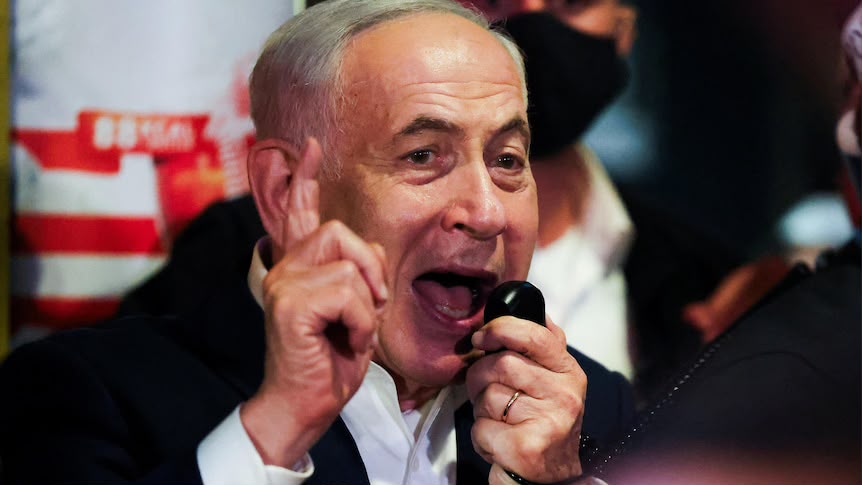
Israelis are voting in a closely contested election shaped by security concerns, the future of democracy and uncertainty over the formation of the next government.
Polling published on Friday suggested that incumbent Prime Minister Benjamin see Netanyahu is in a tight race with former military chief Gadi Eisenkot, leader of the newly formed Yashar Party.9-
Neither candidate’s political bloc is projected to secure the 61 seats needed to form a majority government, raising the possibility of prolonged negotiations and political deadlock.
The campaign has focused heavily on security, with opposition parties blaming Netanyahu for the security failures that preceded the Hamas-led attacks on Israel on October 7, 2023. Nearly 1,200 people were killed in the attacks, while 251 were taken hostage to Gaza.
Opposition leaders have called for an independent commission of inquiry into the attacks, a proposal Netanyahu has resisted, arguing that such a commission would be biased against him.
Netanyahu has defended his record by highlighting what he describes as strategic victories in Israel’s conflicts across the Middle East and his close relationship with United States President Donald Trump.
Israel’s proportional representation electoral system means governments are formed through coalitions. The outcome of the election will therefore depend not only on the candidates’ performances but also on the parties willing to join their respective alliances.
Eisenkot leads the so-called change bloc, a collection of parties united by their opposition to Netanyahu despite differences in their political positions.
The bloc includes former prime minister Naftali Bennett, Avigdor Lieberman and Yair Golan, a left-leaning former general.
Netanyahu’s chances of returning to power depend on securing the support of far-right and ultra-Orthodox parties that currently form his governing coalition.
Arab political parties are also contesting the election. Arab citizens make up about one-fifth of Israel’s population, and their parties could influence coalition negotiations. However, nearly all major Jewish parties have ruled out working with them.
The opposition has also raised concerns about democratic institutions under Netanyahu. The prime minister faces an ongoing corruption trial, which he denies, and continues to pursue controversial judicial reforms that triggered mass protests before the October 7 attacks.
In the final days of the campaign, Israeli media reported that Netanyahu had pushed for military action that could trigger a confrontation with Iran before the election. CNN also reported that he had tried to persuade Trump to authorise further strikes on Iran, but that the US president had declined. Netanyahu denied both reports.
He also drew attention for posting an AI-generated image depicting a nuclear bomb striking Tel Aviv. He warned that he was the only leader capable of protecting Israel if Iran acquired nuclear weapons. Eisenkot described the move as hysterical.
Another major campaign issue is military conscription. Netanyahu’s government has failed to enforce a Supreme Court ruling requiring ultra-Orthodox Jewish men engaged in full-time religious study to serve in the military, a contentious issue as thousands of other Israelis have been called up to fight in recent conflicts.
Also Read: Trump endorses Netanyahu nine days before Israeli election
Eisenkot has taken a broadly similar position to Netanyahu on Gaza. He has pledged to end Hamas rule in the territory within 18 months, either through a US-led peace plan or military action.
Israel has continued to carry out near-daily strikes in Gaza since a ceasefire was agreed last year, saying it targets Hamas operatives. Gaza’s Hamas-run health ministry says more than 74,000 people have been killed by the Israeli military since the war began. The United Nations considers the ministry’s figures reliable.
Israel has faced growing international condemnation over its conduct of the war, contributing to deteriorating relations with allies around the world.
Eisenkot broadly supports Israeli settlements in the occupied West Bank, which are considered illegal under international law. However, he has pledged to crack down on extremist Jewish settlers whose attacks have reached record levels, according to United Nations figures.
He has also discussed creating conditions for Palestinian autonomy or a limited form of statehood under ultimate Israeli security control. The prospect of a two-state solution, involving an independent Palestinian state alongside Israel, has largely receded from mainstream Israeli political debate.
Some observers have speculated that Arab parties could informally support an Eisenkot-led minority government. Lieberman, however, has ruled out participating in such an arrangement.
These competing positions have complicated the path to a governing majority, leaving the outcome dependent on negotiations and possible concessions after the results are announced.
An estimated 70,000 Israelis have returned from abroad to vote, while about half a million people are expected to cast ballots for the first time.
Israeli broadcasters are scheduled to publish exit polls at 22:00 local time on Tuesday. The projections could offer an early indication of the outcome, although exit polls can differ significantly from final results.
Netanyahu’s Likud party is expected to gather in Jerusalem, while Eisenkot’s Yashar Party will assemble in Tel Aviv to follow the results.
Soldiers and reservists will also vote, but many of their ballots will not begin to be counted until Wednesday. Their votes could affect the final distribution of seats.
Although the campaign has largely been framed as a contest between Netanyahu and Eisenkot, another political leader could emerge as prime minister if a party makes its support for a coalition conditional on receiving the top job.
If neither bloc secures a majority and no minority government can be formed, Israel could face another election, with Netanyahu remaining as interim prime minister.
Between 2019 and 2022, Israel held five elections as political parties repeatedly struggled to agree on governing coalitions.
BBC News