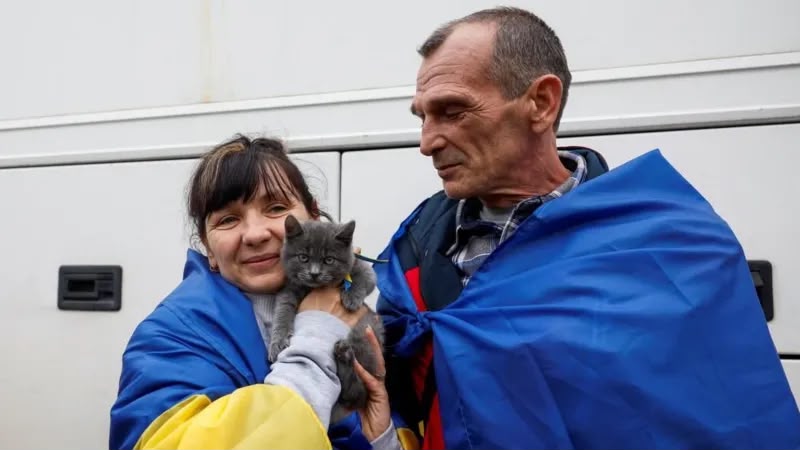
Hundreds of residents evacuated from the war-ravaged Ukrainian city of Oleshky have crossed into government-controlled territory after a temporary ceasefire enabled them to escape Russian-occupied areas.
Ukrainian President Volodymyr Zelensky confirmed on Saturday that the evacuees had crossed into the Chernihiv region, where they would receive humanitarian assistance and support.
“As of now, Ukrainian citizens from Oleshky have crossed the Ukrainian border in the Chernihiv region,” Zelensky said in a post on X.
He thanked government agencies and regional authorities involved in the operation, urging them to help the evacuees settle and access the assistance they need.
Zelensky also acknowledged US First Lady Melania Trump for her efforts in helping secure a local ceasefire that paved the way for the evacuation.
The residents had been trapped in Oleshky, in the Russian-occupied Kherson region, amid severe shortages of food, water and electricity. Conditions reportedly became so desperate that some residents resorted to cooking garden weeds to survive.
A humanitarian ceasefire took effect in parts of the Kherson frontline on Tuesday, allowing residents to leave the city after years of fighting and restrictions.
The temporary arrangement enabled authorities to clear mines along the evacuation route and deliver humanitarian supplies.
Residents were given a four-hour window to leave on Friday before a convoy of 25 buses, with capacity for about 750 people, departed the city. Ambulances were also provided for people with limited mobility.
The evacuation involved a complicated journey through Russian-occupied territory and Belarus before the residents crossed into Ukraine’s northern border on Saturday.
They were transported to the Russian city of Anapa before flying to Gomel in Belarus and continuing by road into Ukraine.
Also Read: Musk accuses Ukraine of violating Starlink terms
Escape from Oleshky had previously been extremely dangerous because roads were mined and exposed to drone attacks. Bridges across the nearby Dnipro River had also been destroyed, while parts of the riverbank remained hazardous.
A resident who fled the city three weeks earlier told the BBC he had walked through 24 kilometres of minefields to reach safety.
The ceasefire measures are expected to remain in place until Sunday, November 1.
Despite the evacuation, several hundred people are understood to have remained in Oleshky, where widespread destruction and shortages of basic services have made daily life difficult.
Before Russia’s full-scale invasion in February 2022, the city had a population of about 24,000. Russian forces seized it during the early days of the invasion.
Ukraine’s human rights ombudsman, Dmytro Lubinets, said on Friday that residents who chose to remain would receive humanitarian assistance.
Lubinets and his Russian counterpart, Yana Lantratova, travelled to Oleshky together on Friday, departing from Armiansk in the Russian-occupied Crimean peninsula.
The visit marked the first time a Ukrainian official had travelled to Russian-occupied territory since the start of the full-scale war, according to the report.
Lubinets said his cooperation with Lantratova was aimed at saving lives, although the sight of the Ukrainian official alongside a representative of the occupying power drew criticism from some Ukrainians.
Russia said on Thursday that it had prepared dozens of tonnes of humanitarian supplies for residents who did not want to leave, including food, medicine, hygiene products and fuel for generators.
Zelensky praised Lubinets and his team for helping secure the evacuation and thanked those who drew attention to what he described as a humanitarian catastrophe in Russian-
occupied Ukrainian territory.
BBC News