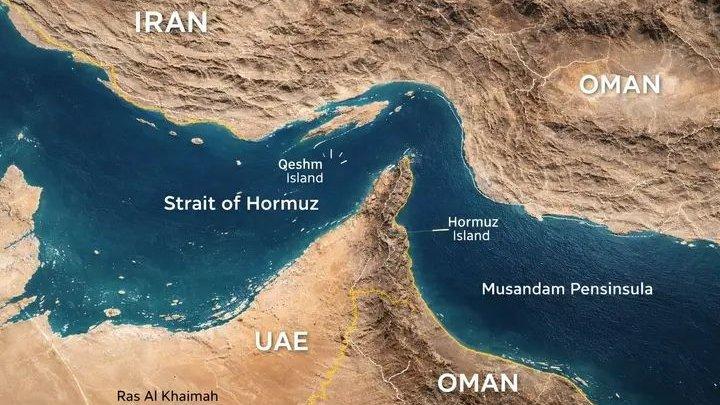
The United States has reportedly carried out limited military strikes on Iran’s Qeshm Island in the Strait of Hormuz, according to American media reports, while Iranian media disclosed that five explosions occurred in quick succession.
The reported operation came as American voters prepared to participate in midterm elections that could affect President Donald Trump’s hold on political power.
The Wall Street Journal first reported the strikes, which reportedly targeted Qeshm Island, a strategically important location along the Strait of Hormuz, a major flashpoint in the Middle East conflict that has disrupted global markets.
Unnamed American officials quoted by The Wall Street Journal, CNN, The New York Times and other media organisations described the operation as defensive.
The Wall Street Journal also reported that the attacks were the latest in a series of military operations that had not been publicly acknowledged.
According to the report, the strikes were not announced publicly to avoid creating the impression that Washington was preparing to restart large-scale military operations.
The United States Central Command had yet to respond to requests for comments on the development.
Washington and Israel began their military campaign against Iran with an extensive wave of attacks in late February. The conflict has remained largely deadlocked for months.
When asked whether Israel participated in the latest reported operation, an Israeli military spokesperson responded, “No”.
Also Read: Houthis step up attacks ahead of Iran talks
Israel also conducted an election last week, with Prime Minister Benjamin Netanyahu’s party emerging ahead but failing to secure an outright majority.
The reported strikes occurred hours after Trump suggested that an agreement with Iran was possible, as the war and its impact on inflation remained major issues ahead of the American midterm elections.
In a post on his Truth Social platform, Trump said, “Iran wants a settlement, as soon as possible.”
Iran’s state news agency, IRNA, reported that five explosions were heard in rapid succession on Qeshm Island, adding that some residents claimed to have spotted two aircraft flying over the area.
However, the agency did not disclose the possible cause of the explosions.
Ball in US court
Meanwhile, Iranian Foreign Minister Abbas Araghchi confirmed that indirect discussions with the United States were ongoing.
Speaking to state media, Araghchi said consultations had intensified because of the seriousness and sensitivity of the situation.
“Given the sensitivity and gravity of the current situation, consultations and deliberations are very intensive,” he said.
Iran’s chief negotiator in talks with Washington, Mohammad Bagher Ghalibaf, also declared that Tehran was prepared for war but had presented the United States with what he described as a rational response.
“The ball is now in America’s court to prevent war,” he stated.
Oil prices reportedly dropped by more than seven per cent on Monday following renewed hopes that the eight-month-old conflict could come to an end.
Iran considers reopening the strait
US Vice President JD Vance said he and Trump remained hopeful that an agreement with Iran could be reached.
“We’ve certainly made some progress. We’ll see if we can make some more,” Vance told journalists on Monday.
China also appealed for a diplomatic resolution, while Iran’s security chief held discussions with Russian President Vladimir Putin over the conflict.
Last week, news outlet Axios reported that Vance had sent a letter to Iranian national security chief Mohsen Rezaei concerning the possibility of fresh negotiations, representing the highest-level diplomatic engagement between both sides in months.
Iranian First Vice President Mohammad Reza Aref described the messages received from Washington as “an acknowledgement of our victory.”
A senior Iranian official also disclosed that Tehran was willing to reopen the Strait of Hormuz within two days, provided Washington accepted its longstanding demands.
In September, Iran presented a seven-day proposal for reopening the strategic waterway. Its conditions included ending hostilities across all fronts, releasing frozen Iranian assets, lifting oil sanctions and terminating the blockade of Iranian ports.
Iranian Foreign Ministry spokesperson Esmaeil Baqaei told reporters that the possibility of implementing the proposal within two days further demonstrated Tehran’s commitment to a peaceful approach.
China backs Iran’s sovereignty
China held separate meetings with Iranian and Saudi officials in Beijing on Monday as diplomatic efforts to address the conflict continued.
During a meeting with Ali Bagheri, Iran’s deputy foreign minister, Chinese Foreign Minister Wang Yi reaffirmed Beijing’s support for Tehran in protecting its sovereignty and security.
Centuryherald