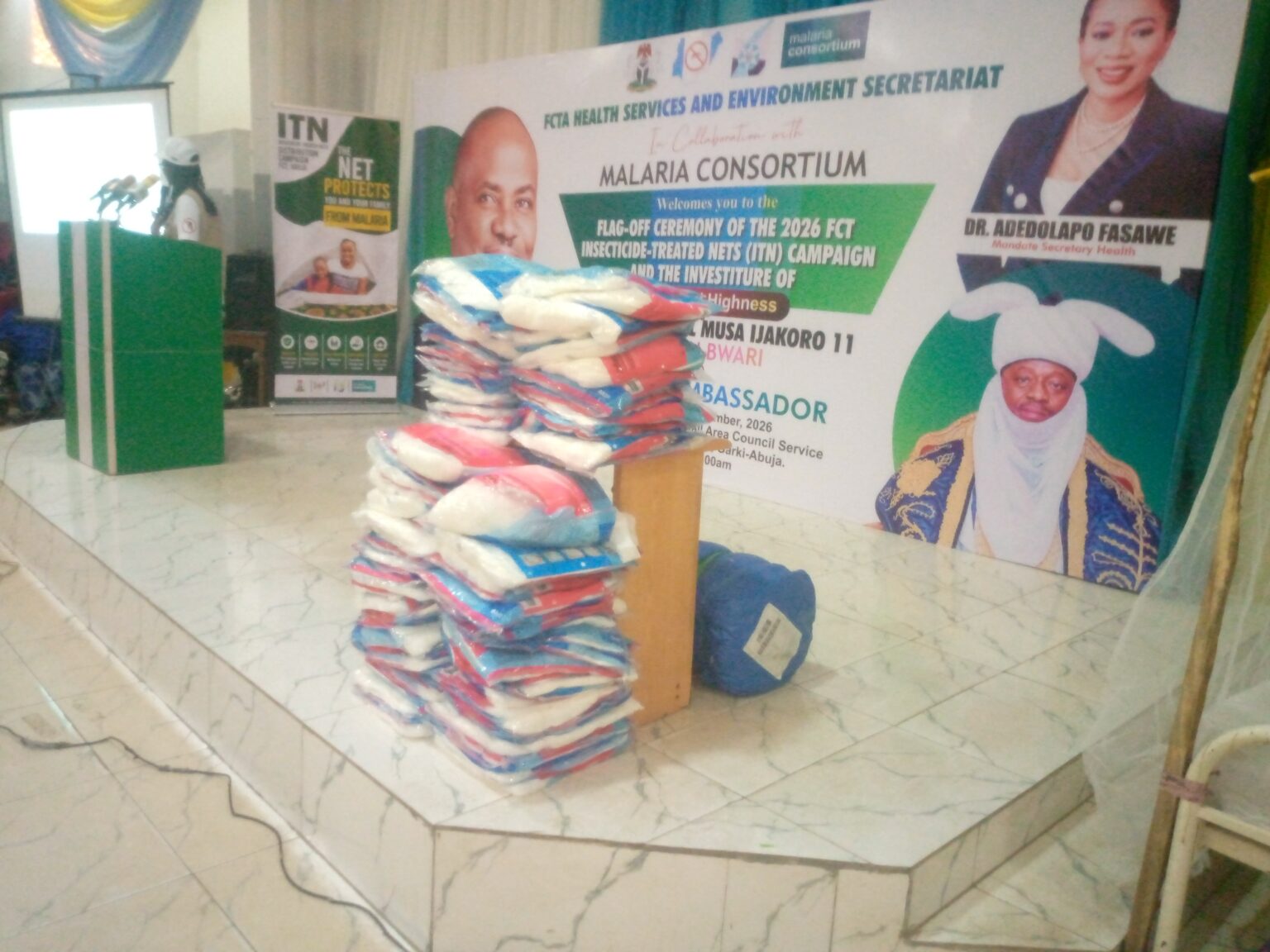
The Federal Capital Territory Administration, FCTA, in collaboration with Malaria Consortium, has launched its 2026 Insecticide-Treated Nets campaign to prevent mosquito bites and reduce malaria transmission across the territory.
The campaign, inaugurated on Saturday, also featured the investiture of the Sarkin Bwari, Alhaji Awwal Musa Ijakoro, as the Federal Capital Territory, FCT, Mosquito Net Distribution Ambassador.
The Mandate Secretary, Health Services and Environment Secretariat, FCTA, Dr Adedolapo Fasawe, said Nigeria recorded an estimated 68 million malaria cases in 2024, representing 24.3 per cent of the global burden.
She said the country also accounted for 30.3 per cent of global malaria-related deaths, particularly among children under five, according to the 2024 World Malaria Report.
Fasawe noted that malaria prevalence in Nigeria declined from 22 per cent in 2021 to 15.3 per cent in 2025, while the FCT recorded a reduction from 18.8 per cent to 7.9 per cent within the same period.
She attributed the improvement to the efforts of health workers, community structures and development partners, but stressed the need to sustain the progress.
According to her, previous assessments showed that only 22 per cent of FCT residents had access to insecticide-treated nets, while just 14 per cent of households slept under them.
Also Read:FCT tenants back bill to curb rent hikes, eviction
She said the campaign would cover all six area councils, including Abaji, Kwali, Gwagwalada, Kuje, Bwari and the Abuja Municipal Area Council.
Fasawe added that the FCTA would collaborate with relevant security agencies to ensure proper supervision and security during the distribution exercise.
The West and Central Africa Programme Director of Malaria Consortium, Dr Kolawole Maxwell, said the decline in malaria prevalence showed the impact of sustained government and community interventions.
However, he warned that fewer than one in 10 FCT households had enough mosquito nets for all family members.
Maxwell disclosed that 4.9 million new nets would be distributed across the six area councils, covering 62 wards through approximately 1,580 distribution hubs.
Similarly, the National Coordinator of the National Malaria Elimination Programme, Dr Nnenna Ogbulafor, said more than 350 million insecticide-treated nets had been distributed nationwide since 2009.
Represented by the Director of the PM-Impact/LLP Project, Mr Philip Okoro, she said the FCT had not conducted a mass distribution campaign since 2011.
She described the 2026 exercise as an important step towards improving access to mosquito nets and reducing malaria cases.
Ijakoro pledged to take the campaign to communities across the territory, urging residents to cooperate with distribution teams when they visit their households.
NAN