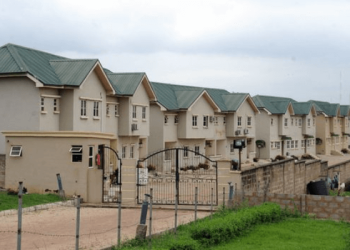
A new development plan is set to revive an Abuja housing project abandoned for 14 years, with 1,348 housing units planned following the recovery of the property by the Independent Corrupt Practices and Other Related Offences Commission, ICPC.
The Managing Director and Chief Executive Officer of the Federal Mortgage Bank of Nigeria, Shehu Usman Osidi, explained that the project was initially designed to provide 962 housing units but was abandoned after the developer failed to complete the houses despite securing a $65 million loan guaranteed by the bank.
According to him, the loan remained classified as a bad debt on the bank’s records for about 10 years before the ICPC intervened and obtained a court order to recover the property.
He said the court also instructed the commission to supervise the bank’s efforts to ensure that the land was developed for its original purpose of providing houses for Nigerians.
Osidi noted that the new developer had demonstrated the capacity to execute the project and submitted a proposal that increased the planned housing units from the initial 962. He initially put the expected number of units at about 1,358.
However, the development plan presented during the inspection indicated that the estate would comprise 1,348 housing units on a 33.29-hectare property.
The engineer who presented the plan explained that the property originally covered about 27 hectares before being expanded through river channelisation and land reclamation.
The proposed estate will feature two-bedroom and three-bedroom flats, three-bedroom terraces and four-bedroom terraces, as well as commercial areas and other public facilities. It will also have a 7.3-kilometre internal road network connecting different sections of the estate.
The ICPC Chairman, Dr Musa Adamu Aliyu, SAN, disclosed that the commission recovered the property in 2023 after the matter remained unresolved for several years.
He said the court directed the mortgage bank to appoint a private developer to reconstruct the estate under the commission’s supervision, while individuals suspected of involvement in the matter were facing criminal trial.
Aliyu described asset recovery as an important strategy in the fight against corruption, noting that African countries lose nearly $150 billion annually to illicit financial flows.
He said recovering and properly utilising such funds could contribute significantly to development across the continent.
The Chairperson of the African Union Advisory Board Against Corruption, Hon. Kwami Edem Senanu, praised the collaboration between the public institutions that facilitated the recovery.
Senanu described the project as a remarkable example of how government agencies could work together to recover lost assets and put them to productive use.
He said the property had remained tied up for about a decade before the institutions found a way to resolve the matter.
He further commended the increase in the proposed housing units, describing the development as an example other African countries could learn from in strengthening asset recovery efforts.
Senanu added that the African representatives looked forward to returning to inspect the completed estate, expressing hope that the houses would be affordable for Nigerians.
Daily Trust