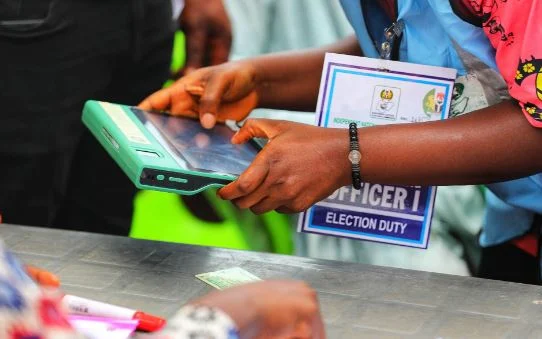
Voters and officials across the country praised the performance of the Bimodal Voter Accreditation System, BVAS, but lamented low turnout and complained of gaps in voter lists as the Independent National Electoral Commission, INEC, on Saturday conducted a nationwide mock accreditation and result upload exercise ahead of the 2027 general elections.
The exercise was meant to test the commission’s equipment and the technology to be deployed in 2027.
In Ondo, the Resident Electoral Commissioner, Dr Mutiu Agboke, said INEC was particularly interested in the speed and functionality of the BVAS and the efficiency of the INEC Result Viewing Portal, IReV.
At one centre visited, Agboke said accreditation took less than a second, unlike in past elections when voters had to try repeatedly before being accredited. “INEC will take note of the challenges observed during the exercise and address them before the general elections,” he said.
Voters in Akure South Local Government Area gave the machines a thumbs-up. Funke Daramola, who voted at Ward 4, Unit 19, Ijomu Obanla, said it took less than two minutes to cast her vote. “I have confidence in INEC. Everything went on smoothly,” she said.
Mrs Stella Daniel said the commission could retain the process for the 2027 election to ensure hitch-free voting, while Mr Olatunji Emmanuel rated the exercise 85 per cent overall but urged INEC to improve where ballot boxes are placed so that elderly people can vote without difficulty.
Similar praise came from Borno and Nasarawa states. In Biu, Mr Ibrahim Yunusa said his accreditation at Miringa Central Primary School 1 took less than six minutes, and that the time fell from about five or six minutes to about three as the exercise progressed.
Also Read: INEC allays fears over BVAS, offline result uploads
“If the real elections go like this (mock), many Nigerians will be more satisfied than they were in previous elections,” he said. The INEC Electoral Officer in Biu, Mr Mukhtar Gidado, described the exercise as successful and hitch-free, saying only two of the 22 BVAS machines deployed had configuration issues, which were resolved.
In Karu LGA of Nasarawa State, community leader Mr Shuaibu Nuhu said officials and materials were on site by 7:00 a.m. and that the BVAS worked seamlessly for the few people who voted.Turnout, however, was low almost everywhere.
In Ebonyi state, NAN correspondents who monitored polling units in Abakaliki, Ebonyi, Ikwo and Ezza-North LGAs found INEC officials and materials in place by 8:40 a.m., but few voters.
At Polling Units 003 and 004, Izzi Unuhu Ward, Nkaliki, Presiding Officer Ahamuefuna Egbuhuzor said only one voter had been accredited and had voted. At Igboji Primary School, Inyimagu, only 10 of 881 registered voters had voted, while Ndufu Alike Ward recorded 27 votes out of 701.
At Community Primary School, Urban Ndufu Echara, only two INEC officials were present, with no voters. The Electoral Officer in Ikwo, Mr Augustine Nweke, said the exercise was held in 40 polling units with 80 personnel. In Nasarawa, two polling units in Karu Ward were allocated only 50 mock ballot papers each.
Residents and officials gave several reasons for the low turnout, chief among them poor awareness. In Biu, many residents were going about their normal businesses, and some told NAN they were neither aware of the exercise nor interested in it.
A councillor in Kpirikpiri ward in Ebonyi, Mr Patrick Aligwe, said INEC had not sensitised the public adequately and that residents were not interested because it was not the main election. He urged the commission to use the National Orientation Agency and other channels.
“The public values information from churches, mosques and social gatherings seriously,” he said. A Biu resident, Isa, who commended the improved BVAS, urged “aggressive sensitisation” and warned that “if this low turnout occurs in 2027, it will be a waste of resources and a regression to the democratic gains we have recorded since 1999.” Mr Gidado said he was dissatisfied with the turnout despite the commission’s sensitisation efforts.
In Ondo state, Mr Emmanuel said the low turnout might be due to environmental sanitation, which people think is being observed, rather than lack of interest.
At Ward 8, Unit 21, Isaipen Imade College, Owo, party agent Mr Olumuyiwa Afolabi attributed it to the electorate’s belief in vote-buying. He said some people told him they were not going to vote because no money was involved, and he urged them to stop selling their votes.
The exercise also exposed problems with voter lists. In Ebonyi, the BVAS functioned smoothly but failed to capture some voters. Mr Chinoso Nkeh said he was disappointed that the machine could not identify him.
“It is my right to be accredited and vote. This is my polling unit, and I am not captured,” he said.
Another resident of Kpirikpiri ward, Mr Chidi Onyekwere, who was also not captured, said he was embarrassed. In Karu, Councillor Daniel Danjuma said some voters had been moved to different polling units without their knowledge.
“A man can be willing to vote but his name has been removed from this centre and he was not aware of it,” he said. He urged INEC to display voter registers at ward headquarters so that voters can confirm their polling units. Mr Nuhu said such transfers could discourage people from voting.
Electoral officers promised action. Mr Ifeanyi Nwonye, an electoral officer in Ebonyi, said the complaints and challenges observed would be tackled. Mr Okechukwu Ugbala, a stakeholder in Inyimagu Ward, expressed satisfaction with the exercise but urged INEC to deploy more BVAS machines in 2027.
Mr Gidado urged residents to collect their Permanent Voter Cards (PVCs), which are available at his office, and Mr Linus Onoja, who was accredited in Karu, said the exercise would help correct lapses before the real election and urged Nigerians to come out and vote.
NAN