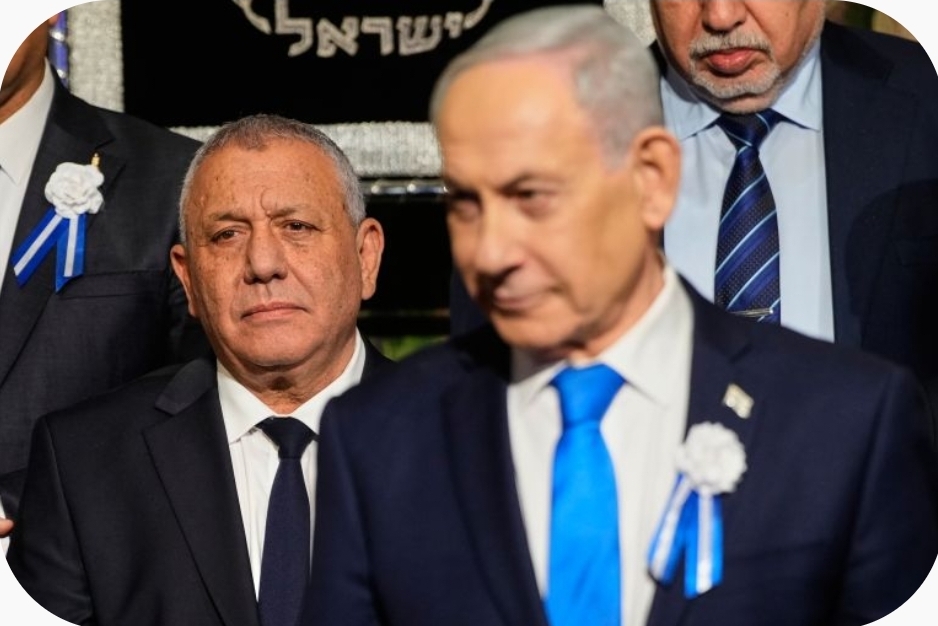
Israel’s Prime Minister, Benjamin Netanyahu, and opposition leader Gadi Eisenkot have begun discussions on forming a national unity government following inconclusive parliamentary elections that left the country politically divided.
The meeting, held on Sunday morning, followed Netanyahu’s announcement on Saturday night that he was willing to allow Eisenkot to serve as prime minister first under a proposed power-sharing arrangement.
A joint statement issued by both parties on Sunday afternoon said the discussions began with a security briefing before moving to the formation of a national unity government. It added that both sides were seeking to bridge their significant differences.
Eisenkot has repeatedly criticised Netanyahu, describing him as unfit to lead the country and a threat to Israel’s future.
Netanyahu, meanwhile, has consistently opposed cooperation with Arab-led political parties, whose gains in the October 27 elections have made them potential partners for the opposition bloc.
Tamar Hermann, director of the Viterbi Center for Public Opinion and Policy Research at the Israel Democracy Institute, described the proposed unity arrangement as a possible attempt to exclude Arab parties from government.
She said that although many Israelis were concerned about the country’s political divisions, voters who supported political change could regard an alliance between Netanyahu and Eisenkot as a betrayal.
Yousef Jabareen, leader of the Joint List, a coalition of three Arab-led parties, urged Eisenkot to reject Netanyahu’s offer.
Also Read: Netanyahu in limbo as Eisenkot prepares to form government
He called on political leaders to respect the shared desire of Jewish and Arab voters to remove Netanyahu from power.
Similarly, opposition leader Yair Lapid, who briefly served as prime minister in a coalition government that ended Netanyahu’s 12-year rule in 2021, described the offer as a political scam.
However, former Prime Minister Naftali Bennett welcomed the proposal, saying a unity government should be built around parties representing Israelis who undertake military or national service.
Although Netanyahu’s Likud party secured the highest number of votes in the election, its traditional right-wing and ultra-Orthodox allies failed to retain a parliamentary majority.
The two major political blocs also failed to secure the 61 seats required to control Israel’s 120-member Knesset, leaving both Netanyahu and Eisenkot facing difficulties in forming a government.
Eisenkot has until December 6 to reach an agreement. If negotiations fail, he could request a two-week extension from Israel’s president to make another attempt.
Should he fail to form a government, Netanyahu could be given the next opportunity, with fresh elections remaining a possibility if both leaders fail.
The proposed coalition has also exposed disagreements among parties supporting Eisenkot, particularly over whether Arab-led or ultra-Orthodox parties should be included in the government.
Other contentious issues in the negotiations include compulsory military service for ultra-Orthodox Jews and the establishment of a state-led investigation into security failures surrounding the October 7, 2023, Hamas-led attacks.
Israel continues to face the consequences of the attacks and the subsequent conflicts in Gaza, Lebanon and Iran, including the joint Israeli-American military offensive against Iran on February 28.
apnews.com