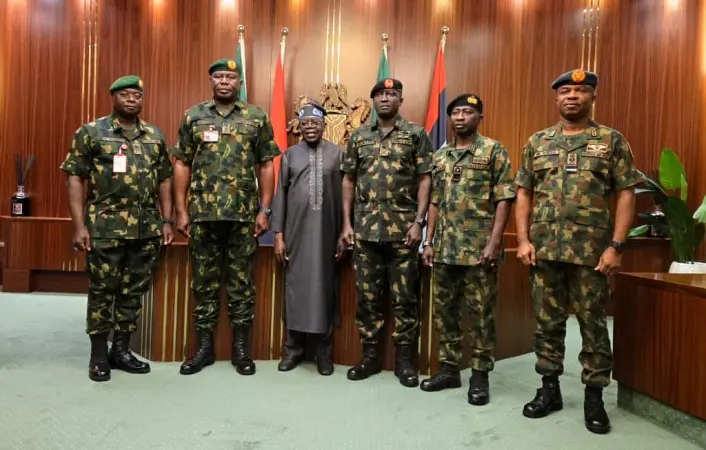
President Bola Ahmed Tinubu on Sunday met with the newly appointed armed service chiefs at the Presidential Villa in Abuja to draw new lines on Nigeria’s security map.
The gathering came just days after the sweeping changes to the country’s top armed forces commanders were announced.
While the precise agenda of the meeting remains undisclosed, sources indicate the focus was on aligning military strategy with national security priorities, improving inter-agency coordination, and reinforcing the country’s defense posture.
These appointments reflect a major shake-up in the military hierarchy aimed at responding to the array of security challenges facing Nigeria — from insurgency in the northeast to banditry in the northwest and unrest in the southeast.
In attendance were the Chief of Defense Staff, Gen. Olufemi Oluyede; Chief of Army Staff, Maj.-Gen. Waheedi Shaibu; Chief of Air Staff, Air Vice Marshal Kennedy Aneke; and Chief of Naval Staff, Rear Adm. Idi Abbas.
The meeting signals a shift in Nigeria’s defense strategy. By bringing the new chiefs together so soon after their appointments, President Tinubu appears to emphasize the urgency of results, cohesion, and strategic clarity. The meeting underlines that this isn’t just about personnel changes — it’s about operational change.
Also read: Tinubu hails latest update by Financial Action Task Force
The new leadership appointments themselves — and the subsequent meeting — send a message to the armed forces that performance, professionalism and accountability are priorities. Establishing early interaction between the president and the chiefs helps to entrench this message.
One of the explicit themes reported is enhancing synergy among the army, navy, air force, and defense intelligence. In an environment where multiple security threats overlap, coordination is critical. The closed session provides a forum to harmonize strategies and avoid duplication.
Such a high-profile meeting acts as a signal — to adversaries, allies, and the Nigerian public — that the government is taking the security situation seriously, and that the new leadership is accountable. It also underscores Nigeria’s commitment to upholding its defense obligations and managing internal security threats.
The exact content or detailed directives given by the president remain undisclosed. Neither the presidency nor the military has released a comprehensive agenda.
Specific timelines, resource allocations, or structural changes stemming from the meeting are not yet public.
How the new leadership will measure success, or what benchmarks will be used, has not been clarified
Whether the meeting included representatives from other security agencies (e.g., police, intelligence services) in addition to the armed forces remains unconfirmed.
Nigeria continues to face multiple security threats including the lingering Islamist insurgency in the northeast, growing banditry and kidnappings in the north-west, and separatist tensions in parts of the southeast.
Prior appointments of service chiefs under this administration have drawn scrutiny — the new appointments and this meeting suggest leadership believes a reset is necessary.
The emphasis on synchronization of armed forces efforts signals recognition of the complexity of Nigeria’s threat environment; no one branch can act alone.
The new leadership may lead to fresh operational initiatives, such as joint taskforces, special operations, or enhanced intelligence-sharing mechanisms.
If the meeting translates into action, there may be increased deployments, more visible security operations, and possibly new rules of engagement or force posture adjustments.
Public expectations may rise — citizens will look for noticeable improvements in safety, especially in high-risk zones.
Structural reform takes time. Changing leadership is just the first step; transforming culture, processes and outcomes takes consistent follow-through.
Resource constraints: Personnel, equipment, logistics, and funding will all be pressures — implementing ambitious directives could be hampered by budget or systemic issues.
Coordination hurdles: While the meeting emphasizes coordination, real overlap between services, intelligence, law enforcement and regional/state actors remains complex.
Managing expectations: Launching new leadership raises expectations. Should improvement falter, public and political disappointment could grow quickly.
President Tinubu’s meeting with the newly appointed service chiefs marks a significant milestone in Nigeria’s security architecture. By convening this leadership so early, he signals that the era of “business as usual” may be over — the government wants results, coordination and accountability.
While the meeting’s full content remains private, the optics and timing matter: they reflect urgency amid complex threats, and hint at a strategic reset. The new military leadership now carries the burden of translating intention into action. For the Nigerian public — especially communities under siege from insurgency, banditry or unrest — the hope is that this gathering will not remain symbolic but catalyze tangible improvements.
The key will lie in follow-through: whether directives become operations, whether coordination becomes synergy, and whether new leadership turns momentum into security for all Nigerians.
Crediblenews