The prospect of U.S. military intervention in Nigeria has stirred concern within Washington’s defense circles, as senior American officials caution that President Donald Trump’s directive may not achieve its intended goals.
While the order aims to “protect Christians” from extremist violence, military planners say that the complexity of Nigeria’s conflict—rooted in sectarian tension, land disputes, and corruption—renders any swift or decisive victory highly unlikely.
Officials from the Pentagon and U.S. Africa Command,AFRICOM, have spent the past week drafting possible responses after Trump’s weekend statement instructing the “Department of War” to prepare for “possible action” in Nigeria.
Defense Secretary Pete Hegseth quickly endorsed the directive publicly, prompting AFRICOM to update long-standing contingency plans for West Africa.
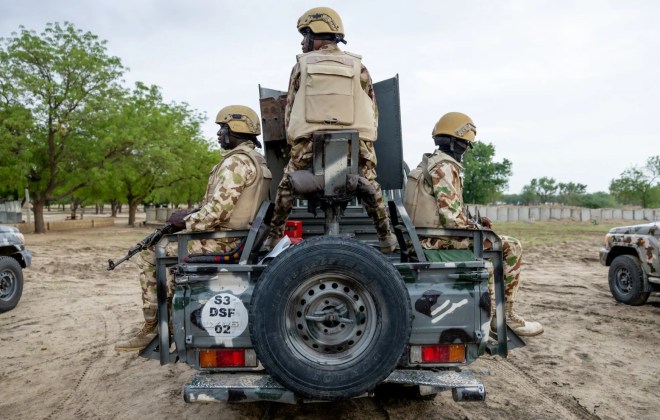
Sources familiar with the process said three options were developed—light, medium, and heavy—each escalating in force and risk. The light option emphasizes “partner-enabled operations,” allowing U.S. advisers to assist Nigerian security forces through intelligence sharing, logistics, and limited joint missions targeting insurgent groups such as Boko Haram and the Islamic State West Africa Province,ISWAP.
The approach mirrors earlier cooperation but would face political constraints and logistical challenges, particularly since the U.S. Agency for International Development closed its office in Abuja earlier this year.
The medium option envisions the use of American drones such as MQ-9 Reapers and MQ-1 Predators to strike militant convoys, camps, and weapons depots across northern Nigeria. Yet that plan has been complicated by the U.S. withdrawal from its drone bases in Niger—Agadez and Niamey—now occupied by Russian forces.
With no nearby launch sites, American drones would have to fly from bases in Djibouti or southern Europe, severely limiting range and responsiveness.
A third, more aggressive “heavy” option includes the deployment of an aircraft carrier strike group to the Gulf of Guinea to conduct large-scale airstrikes in Nigeria’s north.
But military officials have cautioned that such a move would strain U.S. resources already stretched by operations in the Middle East and the Pacific.
READ ALSO:Trump’s Christians ‘genocide’ claim sparks outrage
The Pentagon’s only active carrier in the region, the Gerald R. Ford, has been reassigned to the Caribbean for counter-narcotics operations.
Even if executed, experts warn that an American campaign could yield little lasting impact. Retired Maj. Gen. Paul D. Eaton, who commanded U.S. forces in Iraq, said such an operation risked repeating past mistakes.
“It would be a fiasco,” he said, arguing that airstrikes might produce “shock and awe” but would fail to address the underlying causes of Nigeria’s unrest.
Another senior defense official compared the idea to “pounding a pillow”—dramatic, but largely ineffective.
Analysts also stress that the insurgency in northern Nigeria is not merely religious but intertwined with economic and social grievances.
For decades, competition between farmers and herders, desertification, and weak governance have fueled unrest, providing fertile ground for extremist groups to expand. Boko Haram and ISWAP have targeted both Christians and Muslims, attacking villages, schools, and security forces with equal brutality.
While Abuja has expressed openness to limited U.S. cooperation, it insists that Nigeria’s sovereignty must be respected. Officials in Nigeria fear that a unilateral American intervention could undermine domestic security forces and embolden militants who already exploit anti-Western sentiment. “Nigeria welcomes assistance but on terms that protect its territorial integrity,” a senior government source said earlier this week.
Trump’s directive, issued via social media, has also left some of his own advisers puzzled. Many within the Pentagon question whether the White House has fully considered the risks of escalation, potential civilian casualties, and the diplomatic backlash such strikes could provoke across Africa.
For now, the Pentagon’s proposals remain under review, and no decision has been made on whether to proceed. Still, defense analysts warn that a hasty U.S. intervention—without local coordination and a long-term strategy—could deepen instability in a region already on edge.
“The United States can deliver firepower,” one senior military planner said, “but that won’t bring peace. Without political and economic solutions, bombs will only scatter the problem, not solve it.”
New York Times