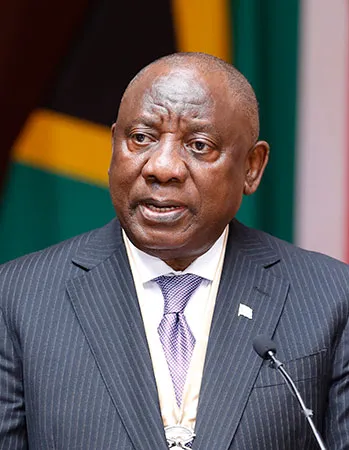
More than a year after the White House expelled South Africa’s ambassador to the United States, Pretoria has made a controversial new appointment to fill the post: Roelf Meyer, an apartheid-era government minister who helped negotiate the end of white minority rule.
Bilateral tensions have been high since February 2025, when U.S. President Donald Trump sanctioned South Africa over false claims of a white “genocide” taking place there. The next month, Washington expelled Meyer’s predecessor, Ebrahim Rasool, for describing Trump’s political movement as “white supremacist.” White South Africans are currently the only group offered priority consideration for refugee status by the Trump administration.
The Trump administration, which has taken steps to dismantle diversity, equity, and inclusion programs in the United States, has also condemned Pretoria’s “Black Economic Empowerment” laws, a form of affirmative action intended to redress the legacy of apartheid.
In August, Trump hit South Africa with a 30 percent tariff (though this was later struck down by the U.S. Supreme Court). Meanwhile, despite pressure from Washington, South African President Cyril Ramaphosa has not severed diplomatic ties with Iran or abandoned his country’s case at the International Court of Justice accusing Israel of genocide in Gaza.
Trump’s appointment of Leo Brent Bozell III—a right-wing activist who in the 1980s opposed U.S. negotiations with the African National Congress to end apartheid—as the U.S. ambassador to South Africa has further worsened relations.
Now, Pretoria is hoping that Meyer, an Afrikaner, will be uniquely positioned to help repair the relationship. Meyer is “someone who has got one foot in the past and one foot in the future of South Africa,” political analyst Ralph Mathekga told Foreign Policy.
Also Read: South African court slams Malema with five years
Meyer was the minister of defense from 1991 to 1992 under South Africa’s white minority government and acted as its chief negotiator during talks to end apartheid. He then served as President Nelson Mandela’s constitutional development minister from 1994 to 1996 and became a parliamentarian before retiring from politics in 2000.
Meyer’s appointment has been described by some analysts as a masterstroke to help fight the White House’s claims of white persecution in South Africa. “Perhaps he can find a way to reset the agenda and be able to knock on the doors,” Mathekga put it. “I think he will not have doors shut on him compared to others that have gone there before.”
Yet the move is not without controversy. Meyer is indeed viewed in South Africa as one of the country’s most experienced negotiators, but, as Mathekga pointed out, “you cannot ignore the optics of this—as if it is only someone who is white who will be accepted” in Washington.
The move has drawn some domestic backlash from both sides of the political spectrum. The left-wing Economic Freedom Fighters party said it was “tone deaf” to appoint a white apartheid-era politician. And for some South Africans, Meyer is a symbol of post-apartheid South Africa’s inability to move beyond its past, as the country is still home to what the World Bank assesses to be the world’s most extreme racial and economic inequality.
Meanwhile, Kallie Kriel, the head of Afrikaner lobby group AfriForum, called Meyer an “ANC cadre” whose “history shows that he is someone who is willing to dramatically reposition himself to suit his own personal interests.”
Meyer’s “most immediate” priority, according to Mathekga, will be the “de-escalation of tensions.” The bilateral relationship is critical to South Africa’s economy: Washington is one of Pretoria’s top trading partners, and a reduction in exports to the United States has threatened thousands of South African jobs.
At the same time, South Africa—Africa’s largest economy and most industrialized nation—is an important economic partner to the United States.
“The economic reality is that U.S.-South Africa relations cannot be reduced to simplistic political narratives. Approximately 600 American companies operate in South Africa, employing thousands and generating billions in bilateral trade,” Imraan Buccus wrote in Foreign Policy last year.
South Africa is also critical to U.S. ambitions to counter China’s rare-earths dominance. Despite ongoing tensions, the U.S. government moved forward last week with a $50 million investment in South Africa’s Phalaborwa Rare Earths Project.
Although the U.S. International Development Finance Corporation (DFC) made the funding commitment in 2023 under then-U.S. President Joe Biden, the Trump administration has chosen to continue with the project, which the DFC refers to as a way of “advancing U.S. strategic interests.”
Africa Brief