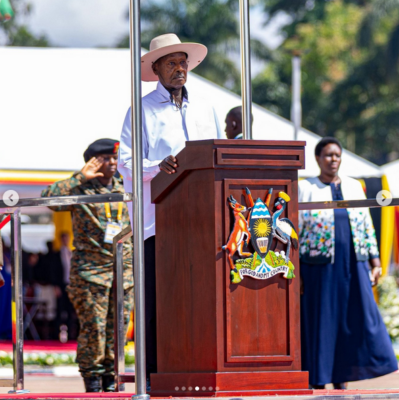
Ugandan President Yoweri Museveni has been sworn in for another five-year term, extending a presidency that has lasted nearly four decades amid growing attention on the country’s succession politics.
The 81-year-old leader took the oath of office on Tuesday during a ceremony attended by thousands at Kololo grounds in Kampala, the Ugandan capital, marking his eighth inauguration since assuming power in 1986.
The event featured a large military parade supervised by Museveni’s son and army chief, Muhoozi Kainerugaba, who is widely viewed as a possible successor to the longtime president. Russian-made Sukhoi fighter jets also flew over the venue as part of the celebrations.
Earlier reported that Uganda’s Electoral Commission had earlier declared the incumbent winner of the poll after he secured more than 7.9 million votes, comfortably defeating his closest challengers. Chairperson of the electoral commission, Simon Byabakama, announced that Museveni surpassed the constitutional threshold requiring a candidate to obtain more than 50 per cent of valid votes cast.
The election, however, was conducted under tense conditions, with reports of internet shutdowns and restrictions placed on opposition parties and civil society groups during the voting process.
Museveni’s victory further extends his uninterrupted leadership, which has spanned more than 30 years, despite growing domestic and international criticism over governance, electoral credibility, and political freedoms in the country.
Also Read:Ugandan politician face death penalty threat
In a related development, former President of Ghana, John Dramani Mahama, has signed into law three major pieces of legislation aimed at strengthening state institutions, improving accountability, and expanding access to legal education.
The newly enacted laws include the Legal Education Act, the Value for Money Office Act, and the Governance Advisory Council Act, all recently passed by Parliament.
Mahama said the Legal Education Act represents a significant reform in Ghana’s justice system. The law ends the long-standing monopoly of the Ghana School of Law over professional legal training, opening the sector to more institutions. According to him, the move will introduce healthy competition, improve standards, and create more opportunities for aspiring lawyers.
He noted that the Value for Money Office Act is designed to ensure transparency and efficiency in public spending. The new office will be responsible for reviewing major government contracts and expenditures, with a mandate to prevent inflated costs, eliminate waste, and ensure that public funds deliver tangible benefits to citizens.
On governance, Mahama said the Governance Advisory Council Act establishes an independent body to promote accountability and combat corruption. The council is expected to advise on governance practices and help strengthen public trust in leadership.
He described the three laws as part of broader efforts to protect the interests of Ghanaians and reinforce institutional integrity.
The former president signed the bills before departing Accra for Nairobi, reaffirming his administration’s commitment to reforms aimed at improving governance and national development.
TVC NEWS