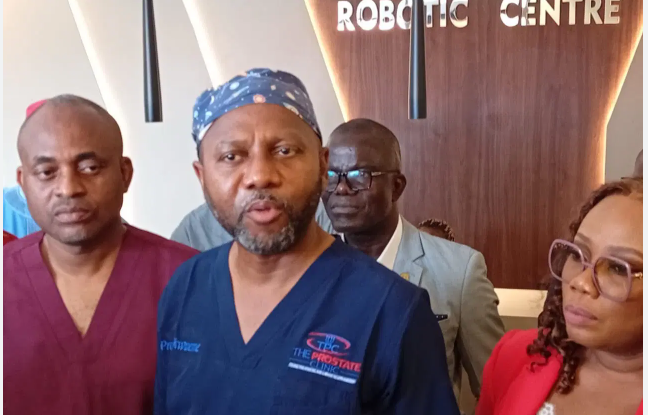
Imo State has recorded its first robotic-assisted surgery following the successful completion of a procedure at the Imo Robotics and Oncology Centre, IROC, located within the Imo Specialist Hospital Complex, Umuguma, Owerri.
The landmark operation was performed by a team of Nigerian and international medical specialists led by Professor Kingsley Ekwueme, a UK-based consultant robotic and laparoscopic surgeon and lead urological surgeon at Glan Clwyd Hospital, United Kingdom.
The development marks a significant expansion of the state’s capacity to provide specialized surgical and cancer care locally.
Ekwueme, who spoke to journalists after the procedure, described the operation as a complete success and highlighted the potential of robotic-assisted surgery in treating localized prostate cancer.
According to him, the technology gives surgeons greater precision when removing cancerous tissue while helping them preserve structures associated with urinary and sexual function.
He said this is particularly important in prostate cancer surgery, where damage to surrounding nerves and tissues can affect a patient’s quality of life.
“The success rate of robotic surgery for cancer, especially prostate cancer, is phenomenal,” Ekwueme said, stressing that patients should not have to endure prolonged urinary incontinence or loss of sexual function following prostate surgery.
Robotic-assisted radical prostatectomy is a minimally invasive approach in which a surgeon controls specialized instruments through a robotic system.
The technology does not independently perform the operation; rather, it provides the surgeon with enhanced visualization, precision and instrument control.
Evidence from systematic reviews has found that robotic-assisted prostatectomy can offer advantages in functional recovery compared with some conventional surgical approaches, although outcomes depend on factors including the surgeon’s experience, the patient’s condition and whether nerve-sparing techniques are appropriate.
The development is particularly relevant to prostate cancer care in Nigeria. Data from the International Agency for Research on Cancer’s GLOBOCAN 2022 estimates show that Nigeria recorded 18,019 new prostate cancer cases that year, making prostate cancer the country’s leading cancer among men and the second most commonly diagnosed cancer overall.
The centre is therefore expected to strengthen access to specialized treatment for patients who may otherwise need to travel to other parts of the country or outside Nigeria for complex procedures.
Also Read: FCTA trains health workers to strengthen emergency care
The facility forms part of broader efforts by the Imo State Government to upgrade the Specialist Hospital and develop capacity for advanced oncology and minimally invasive surgery.
Governor Hope Uzodimma, who witnessed the procedure, described the achievement as a major step towards providing residents with quality and affordable healthcare.
Uzodimma said the facility was designed to serve not only as a treatment centre but also as a platform for early detection and prevention through routine medical examinations.
He also emphasized the importance of building local expertise alongside the acquisition of sophisticated medical equipment, saying the state’s objective was to ensure that advanced technology was supported by appropriate training and skills transfer.
The governor said the centre operates through a public-private partnership, with substantial funding coming from the private sector.
According to him, the arrangement is intended to support the sustainability of the facility while maintaining standards in its management and service delivery.
The robotic and oncology centre was developed as a joint initiative involving the Imo State Government and private-sector partners, with preparations for the project intensifying months before the first procedure.
Uzodimma also urged residents to enrol in the Imo State Health Insurance Scheme, saying wider insurance coverage would help make advanced medical treatment more affordable and accessible.
The introduction of robotic surgery comes as Nigerian hospitals increasingly explore technology-driven and minimally invasive approaches to specialized healthcare.
In April 2025, Ekwueme was reported to have performed West Africa’s first robotic-assisted prostate cancer surgery at The Prostate Clinic in Lagos, using a da Vinci robotic system.
For Imo State, the successful procedure represents the transition of the robotic surgery project from planning and infrastructure development to actual clinical service.
The longer-term impact will depend on sustained access to the technology, availability of trained personnel, appropriate patient selection, follow-up care and the ability to make the specialized services financially accessible to residents.
The state government has presented the milestone as part of its broader healthcare transformation agenda, with the expectation that the new capacity will improve access to advanced treatment while reducing the need for patients to seek specialized care outside the state or country.
Leadership