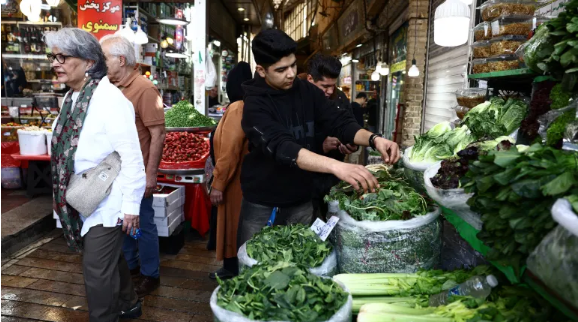
Iranians are preparing for further economic hIranians braceardship as the United States gets ready to announce a new round of measures targeting Iran’s economy amid the ongoing war between the two countries.
US Treasury Secretary Scott Bessent is expected to announce the measures on Monday, with Washington seeking to intensify financial pressure on Tehran and weaken its ability to sustain its economy.
US President Donald Trump has described the planned measures as an “economic D-Day”, suggesting that Washington is preparing some of its most aggressive financial restrictions against Iran.
The measures could expose banks, oil buyers and refiners, shipping companies, ports, airports, exchange houses and front companies involved in Iranian trade to secondary sanctions.
Governments and other entities that continue to facilitate Iranian trade could also face penalties from Washington.
Trump, in a social media post on Monday, claimed that Tehran was “completely collapsing”, as the economic confrontation between the two countries continued to intensify.
However, analysts say tougher sanctions may not necessarily force Iran to change its behaviour, given the country’s long experience of operating under extensive international restrictions.
Iran has been under a US “maximum pressure” campaign since Trump’s first term in office in 2018. The campaign followed Washington’s unilateral withdrawal from the nuclear agreement reached three years earlier between Iran and world powers. The agreement had provided sanctions relief in exchange for verified restrictions on Tehran’s nuclear programme.
Since then, Tehran has developed a sophisticated system for circumventing sanctions and maintaining access to international markets.
Its methods include the use of a shadow tanker fleet, ship-to-ship transfers of oil, shell companies, alternative payment arrangements and barter systems.
The US Central Command said on Sunday that its forces had redirected 70 commercial vessels, disabled three and boarded two as part of the blockade, which Washington says could continue indefinitely.
Despite the pressure, Tehran’s extensive land borders, railway networks and access to the Caspian Sea provide Tehran with alternative routes for trade.
Energy strategist and George Mason University senior visiting fellow Umud Shokri said Tehran had become increasingly experienced in finding ways around US sanctions.
Also Read: Iran warns of fresh offensive as ceasefire expires
“Tehran has learned how to survive under pressure, although survival is not the same as avoiding economic damage,” he said.
The mounting pressure has also affected Iran’s currency and purchasing power. The Iranian rial fell to a new record low on Monday, trading at about 2.03 million rials to the US dollar on Tehran’s open market.
The weakening currency has increased pressure on households as the cost of imported goods and essential commodities rises.
The country is also dealing with regular power blackouts, while the government has introduced a range of planned austerity measures as it attempts to manage the worsening economic situation.
Tehran has expanded overland trade through Iraq, Türkiye, Pakistan, the Caucasus and Central Asia while relying on local currencies, barter arrangements, intermediaries and discounts to keep trade moving.
However, these measures have not fully compensated for losses in oil revenue, leaving the Iranian economy vulnerable to further shocks.
Iranian military officials have responded defiantly to the threat of additional US sanctions. Mohsen Rezaei, the new secretary of Iran’s Supreme National Security Council, warned countries that support the planned US economic measures that they could be regarded as enemies of Tehran.
He also threatened to halt oil exports through the Strait of Hormuz and other parts of the Persian Gulf if what he described as an economic war continued. “If the economic war continues, not a single drop of oil will be exported,” Rezaei said.
Iran’s Army Chief, Amir Hatami, also said the country’s forces were prepared for a prolonged confrontation, saying they could continue fighting for generations if necessary.
He argued that Tehran needed to demonstrate through military strength that the US could not achieve its objectives in Iran or the strategically important Strait of Hormuz.
Meanwhile, Iranian President Masoud Pezeshkian has taken a different position, saying it would be better to end the war with the US from a position of strength.
China remains Iran’s most important economic partner, particularly because of its demand for Iranian oil. According to Shokri, Chinese purchases have provided Tehran with an important economic lifeline and helped cushion the impact of US restrictions.
However, he noted that major Chinese banks and companies with significant exposure to global markets remain cautious about transactions that could threaten their access to the US financial system.
Smaller and less internationally exposed Chinese refiners, he said, are generally more willing to take the risk of dealing with Tehran.
China’s Foreign Ministry said on Monday that sanctions and pressure would escalate tensions rather than resolve the conflict.
Other regional countries, including Türkiye, Iraq, the UAE and countries in Central Asia, could also help Iran maintain alternative trade routes.
However, analysts say these countries lack the economic capacity of China and could reduce their involvement if US secondary sanctions become sufficiently costly.
The latest measures are therefore expected to increase pressure on Iran’s already weakened economy while testing Tehran’s ability to maintain trade, protect its currency and sustain its economy under continued US pressure.
Al Jazeera