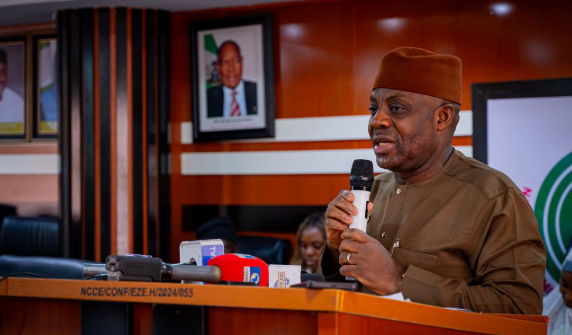
The Federal Government has warned tertiary institutions against borrowing staff and equipment to meet accreditation requirements, saying officials who manipulate the process risk losing their jobs while private institutions could have their licences revoked.
Minister of Education, Tunji Alausa, issued the warning at the inauguration of a ministerial committee on strengthening accreditation and quality assurance in tertiary institutions, saying the government would no longer tolerate institutions presenting inflated or misleading records of their academic capacity during accreditation exercises.
He said accreditation should reflect an institution’s actual and sustainable capacity, rather than a temporary representation assembled solely for an accreditation visit.
“An institution should not be able to prepare a temporary picture of itself simply for the purpose of an accreditation visit. Sadly, this is what persists in the majority of instances,” the minister said. Alausa warned that officials and institutions that undermine the accreditation process would face consequences.
“People say they want to hire engineers. They will have 500 candidates, but they won’t be able to get two, three, four or five qualified applicants. That’s the damage we’re doing to this university,” he said.
“But guess what? This Ministry of Education is not going to let this continue. Other presidents, other governments may have allowed this to continue, but we are not going to let this continue.
“And at the end of this, there will be consequences. You will go and represent the others, and your institution will lose its standing.
“The world will put the consequences in place. You will lose your job if you don’t act on time. Private institutions will lose their licences,” he said.
The minister said the National Universities Commission, National Board for Technical Education and National Commission for Colleges of Education should ensure institutions maintain prescribed standards throughout the year.
Also Read: WAEC defends integrity as schools query WASSCE results
“Before an accreditation team arrives, the accrediting agency should already have reliable information on institutional staffing, facilities, laboratories, workshops and other equipment,” he said.
“The physical visit will remain important, but it should increasingly serve to validate verified data rather than begin the verification process from scratch.”
Alausa directed the committee to develop mechanisms for verifying the authenticity and continuous availability of academic and non-academic staff presented for accreditation.
He said technology would play a major role in digitizing the accreditation process and called for the use of geospatial mapping, geotagging and appropriate digital identification technologies for physical infrastructure, laboratories, workshops and major equipment.
“Critical equipment presented for accreditation should be capable of being digitally identified and linked to a specific institution and physical location,” he said.
The minister also advocated digital identity systems to verify personnel presented for accreditation and detect cases where an individual is improperly presented as full-time staff in multiple institutions.
He said collaboration with the National Identity Management Commission should be explored to use the National Identification Number alongside the appropriate use of Bank Verification Number infrastructure and other secure technologies.
Alausa also expressed concern over illegal admissions into tertiary institutions, saying the number had reached hundreds of thousands.
He attributed the situation partly to the tolerance of irregularities under previous administrations but said the President Bola Tinubu administration would no longer allow such practices to continue.
The minister’s position comes amid controversy over the Council of Legal Education’s 10-year ban on the law programme at Atiba University, Oyo, over inadequate facilities and other accreditation infractions.
The Cable