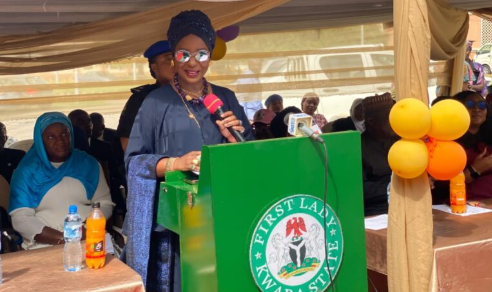
Women and girls in Kwara State are set to gain greater access to digital education and economic opportunities following the inauguration of the Olufolake Women ICT E-Learning and Skills Acquisition Centre in Ilorin.
The centre, an intervention supported by the National Information Technology Development Agency, NITDA, would, according to the wife of Kwara State Governor, Amb. Olufolake, bridge the gender gap in technology while equipping women with skills needed to participate effectively in the emerging digital economy.
She said the centre was designed to provide market women, young female graduates and marginalized girls with access to digital education, ICT tools and skills acquisition.
According to Abdulrazaq, inadequate access to laptops, mobile phones and other digital tools has contributed to low levels of digital literacy among some women in the state.
She said the new facility would provide beneficiaries with opportunities to develop skills in areas including digital content creation, e-commerce, data analysis and technology-driven entrepreneurship.
The governor’s wife described digital literacy as essential for professional development, socio-economic relevance and competitiveness in the modern marketplace.
She, however, noted that technology-driven empowerment should be complemented by vocational training and financial capacity.
She said the centre therefore combines ICT education with skills acquisition to provide women with a broader range of tools for economic empowerment.
Abdulrazaq said skills acquisition remained a major component of the economic empowerment programmes of her office and the Ajike People Support Centre.
She noted that women and young people had previously benefited from vocational training, start-up tools and financial literacy programmes.
Also Read: Northern women Ulamas endorse Tinubu for second term
She urged beneficiaries of the new centre to take ownership of the facility and make effective use of the available resources. “It is my sincere belief that excellence from this hub will reverberate across the country and beyond,” she said.
The Commissioner for Women Affairs, Chief Opeyemi Afolashade, described the initiative as an opportunity for women to turn ideas into enterprises and skills into wealth. He commended the governor’s wife for her interventions in gender equity and economic empowerment.
She said thousands of women across Kwara’s 16 local government areas had benefited from grants, agricultural inputs, start-up tools and vocational training through the Ajike People Support Centre.
She also highlighted Abdulrazaq’s advocacy, alongside Governor Abdulrahman Abdulrazaq, for the enactment of the Kwara State Gender Equity Bill. According to her, the legislation represented a significant step towards promoting gender inclusion in the state.
The Commissioner for Communications, Hon. Bolanle Olukoju, said the centre would give women the opportunity to acquire ICT skills, explore emerging economic opportunities and develop sustainable businesses. She added that access to digital knowledge could help women achieve greater financial independence.
Similarly, the Commissioner for Education and Human Capital Development, Dr Lawal Olohungbebe, urged women to embrace information technology, describing it as one of the major economic resources of the present generation.
Olohungbebe encouraged women to take advantage of the facility and acquire relevant digital skills to position themselves for opportunities in the technology-driven economy. “Women should be well equipped, so that they can live independently and not live as parasites,” he said.
The News Agency of Nigeria reports that the centre was facilitated through the advocacy of the Kwara Governor’s wife and supported by NITDA.
The initiative is aimed at promoting digital inclusion, skills development and economic empowerment among women in the state.
With the new facility, beneficiaries are expected to gain access to digital tools and training that can help them develop businesses, improve professional skills and participate more effectively in the growing digital economy.
NAN