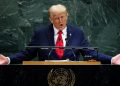
President Donald Trump has warned that he could “annihilate” Iran if Tehran fails to reach a deal with Washington, while defending his military campaign against the country at the United Nations General Assembly.
Addressing world leaders on Tuesday as the UN’s annual high-level debate opened in New York, Trump said Iran was no longer the dominant power it once was in the Middle East.
“They were the bully of the Middle East, but they are the bully no more,” he said.
Trump said he had remained committed throughout his political career to preventing Iran from acquiring nuclear weapons.
“I will never allow Iran to have a nuclear weapon,” he said.
Iranian representatives in the assembly hall listened to the remarks without any emotions, apparently used to Trump’s boastful exaggerations.
The United States and Israel launched military operations against Iran on Feb. 28, with Tehran retaliating with attacks across the region.
Trump described the military campaign as having inflicted extensive damage on Iran’s military capabilities.
“As a result of Operation Epic Fury, all 159 ships of their navy are now lying at the bottom of the sea,” he said.
“Likewise, their air force is gone. Their radar is gone. Their anti-aircraft equipment is gone. Their missile and drone manufacturing capacity is almost gone. Their economy is gone.”
Also Read: White House launches ‘Trump TV’ amid US media access row
Trump then raised the possibility of destroying the Islamic Republic if Tehran failed to reach an agreement with Washington.
“I have a big decision to make,” he said, outlining a deal with Iran as one option.
“Or do I annihilate the Islamic Republic, and do it quickly, never giving them a chance to kill and destroy people and countries again?”
“Do I drive them into hell with no chance of survival and no hope of future greatness or generations?” he asked.
Trump, however, said he believed Tehran would eventually agree to a deal, possibly after the US midterm elections.
His remarks came as the conflict continued to create political and economic pressure in the United States, particularly over energy prices.
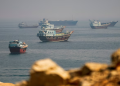
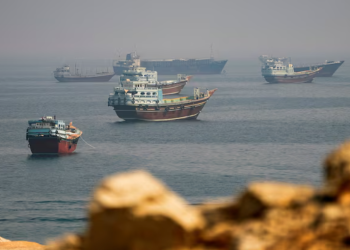
The dispute over Iran’s nuclear programme has also been overshadowed by tensions over the Strait of Hormuz, a major route for global oil shipments.
Iran threatened and attacked shipping through the strait after the conflict began, contributing to higher global oil and petrol prices.
The increase in energy costs has added to domestic pressure on Trump and his Republican Party ahead of the November midterm congressional elections.
The conflict has also faced growing opposition in the United States as it approaches seven months, with the war lasting longer than the period Trump initially indicated it would take.
NAN