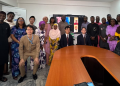
The Nigerian Communications Commission, NCC has urged participants in the telecommunications industry to adopt infrastructure sharing to cut expenses and enhance service provision.
Aminu Maida, the Executive Vice-Chairman of the Commission, conveyed this message during the 2nd edition of the West African Telecoms Infrastructure Summit and Exhibition held on Friday in Lagos.
In addition to sharing infrastructure, Maida also emphasized the need for partnerships between government, industry, and academia to drive innovation and development.
He said, developing telecoms infrastructure is capital intensive, hence, public-private partnerships, infrastructure funds, and innovative financing models like Infrastructure as a Service (IaaS) should be considered by the industry players.
Speaking on infrastructure challenges in the industry and the strategies to address them, Maida, who was represented by Mr Victor Adoga, Head of Next Generation Technology and Standards at the NCC, said: “today, we boast of over 219 million mobile subscribers and a burgeoning tech-savvy population eager to harness digital technologies.
“However, while our growth has been remarkable, it has not been without its challenges. Issues such as uneven service distribution, infrastructural deficits, and regulatory uncertainties have occasionally hindered our progress.
“Yet, each challenge also presented a unique opportunity for growth and innovation.”
On the strategies the operators could adopt, the NCC boss advised them to leverage emerging technologies such as AI to optimize their networks.
“Integration with AI and machine learning to optimize network management, predict maintenance needs, and enhance customer service through automation and advanced analytics is also necessary.
“Another strategy is developing smart infrastructure, because as cities become smarter, telecom infrastructure must evolve to support an array of smart city applications, from traffic management systems to public safety solutions,” he said.
READ ALSO: NCC advocates more investment in local talent for growth of digital economy
While noting that Nigeria has been actively participating in the emerging technology trends globally with the rollout of 5G, Maida said 5G promises higher speeds, lower latency, and greater capacity, facilitating new applications such as the Internet of Things (IoT), autonomous vehicles, smart cities, and advanced augmented reality.
“The future beyond 5G, looking towards 6G, suggests further enhancements in network capabilities and the integration of Artificial Intelligence (AI) to manage network operations and service delivery. It requires substantial investments in both hardware and spectrum allocation.
“With the Internet of Things (IoT), everyday objects are connected to the internet, gathering and sharing data,” he was quoted by Nairametrics to have said.
Maida said that the 6G revolution would transform industries from agriculture to healthcare, creating efficiencies and improving lives.
The NCC boss concluded that, “for telecoms, it means a massive increase in connected devices and a shift in data management strategies.”