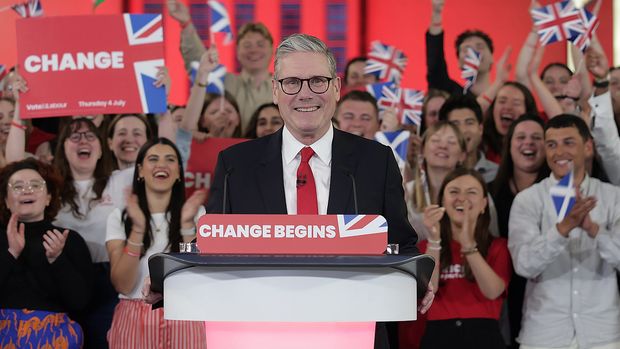
The U.K.’s opposition Labour Party won a huge parliamentary majority in the country’s general election, unseating the incumbent Conservatives after 14 years.
Early on Friday morning, Labour passed the threshold needed to govern alone as outgoing PM Rishi Sunak conceded defeat. Keir Starmer, leader of the center-left Labour, will become the country’s next prime minister and declared victory in the early hours.
“We did it,” he said, addressing his Labour colleagues. “You campaigned for it, you fought for it — and now it has arrived… change begins now.”
Some projections show Labour will gain its second-largest majority after former Prime Minister Tony Blair’s 179-seat majority in 1997.
Millions of people across England, Scotland, Wales and Northern Ireland on Thursday voted for their local representatives in the 650-member House of Commons, the U.K.’s lower house of parliament. Ballots are still being counted, with constituencies announcing their winning candidate as soon as votes are tallied.
What Labour’s win means for UK markets
The arrival of a new Labour government hasn’t moved markets all that much yet but analysts expect U.K. assets to become more attractive from here on out.
In a note Friday, analysts at Jefferies said, despite concerns raised by a strong showing for the right-wing Reform UK Party, the Labour Party’s U.K. election win would help make the U.K. appear “relatively stable.”
This, in combination with regulatory reform, “could raise the attractiveness of UK assets,” Jefferies’ analysts wrote in a research note.
Beata Manthey, European equity strategist at Citi, noted that history shows U.K. markets tend to trade flat on average six months after Labour wins, but “meaningfully higher one year later.”
“On a relative basis, the UK market has tended to underperform 1-2 months after Labour wins, while tallying decent relative performance 12m post-election,” Manthey said.
“The domestically oriented FTSE 250 has typically outperformed the FTSE 100 following Labour victories. Sterling and Gilts will be key to watch,” she added.
READ ALSO: UK exits recession with stronger-than-expected growth
Analysts expect Labour government to boost housebuilders
The U.K. housebuilding market is set to benefit from an incoming Labour government, several bank analysts wrote in research reports Friday.
In a note, analysts at RBC Capital Markets said that if Labour’s election pledges turn into policy, this could mark the dawning of a “new age” for U.K. housebuilding.
“Over the last few years housebuilders’ potential has been hamstrung, but over the next few this potential is likely to be unleashed,” the bank’s analysts wrote in their note.
“If the new Government’s walk matches its talk we expect the sector to re-rate, and in the very short term we suspect that the talk alone will be enough to lift share prices,” they added.
Expect to see the reinstatement of housing targets, refining of the greenbelt, a reform of planning, and the announcement of a “new generation of new towns,” the RBC Capital Markets analysts wrote.
Meantime, Investec analysts said they expect housebuilders to “benefit from a more supportive planning backdrop as a significant part of the political hiatus around planning is removed.”
“Even in the absence of any significant new policy support aimed at the first-time buyer and demand side, expected interest rate cuts should ease affordability constraints and boost sentiment.”
“With negligible build cost inflation, a more favorable demand and supply backdrop should support a recovery in 2025,” Investec’s analysts added.
Credible News.ng