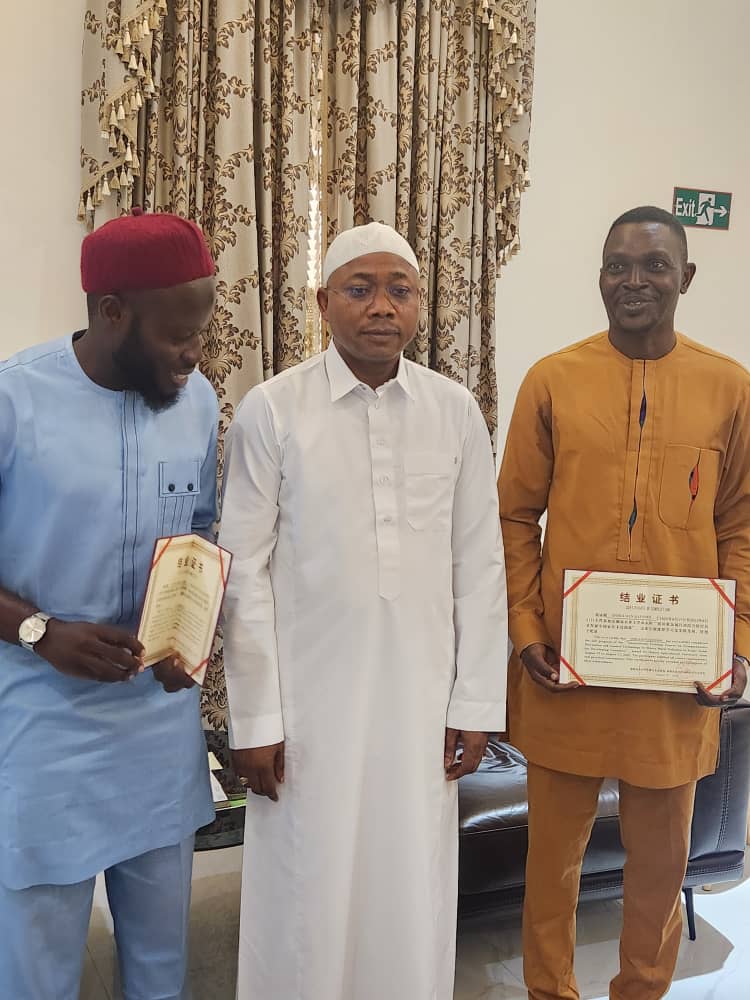
The partnership between Kogi State and Hunan Province, China, has formally kicked off with the completion of a three-week agricultural training programme for Nigerian lecturers at Hunan Agricultural University in Changsha City.
Governor Ahmed Usman Ododo, while receiving the first batch of returning participants, said the training represents the first visible dividend of the Kogi–Hunan partnership, a deal that spans agriculture, mining, industrialization, and other strategic areas of the state’s economy.
According to Ododo, the focus of the programme — Heavy Metal Control and Prevention in Paddy Fields — was not only timely but also directly relevant to Kogi’s agricultural needs.
He explained that the initiative stemmed from his official visit to Hunan earlier in the year, where he requested capacity-building support under the broader mutual economic cooperation agreement with the People’s Republic of China.
“This initiative has equipped our lecturers with cutting-edge knowledge and innovative strategies to manage heavy metal contamination in rice cultivation, which is highly relevant to Kogi State’s agricultural landscape,” Ododo said. “It is the beginning of many more exchange programmes to be facilitated by the state government.”
The governor further reaffirmed his administration’s resolve to harness the partnership for unlocking Kogi’s vast agricultural and mineral resources, boosting industrial growth, and driving sustainable development.
ALSO READ: Kogi moves against drug menace with new 26-member committee
Participants in the exchange programme hailed the training as transformative. Dr. Ajayi Joshua and Mr. Sadiq Fatihu, both of the Faculty of Agriculture at the Confluence University of Science and Technology, said the experience opened new frontiers in research and practical applications.
Dr. Joshua noted that the sessions broadened their understanding of sustainable agricultural practices, while also exposing them to opportunities for future collaboration with Hunan Agricultural University. “The programme was an eye-opener.
It has expanded our research horizons and given us a clearer perspective on how technology can improve productivity and sustainability in agriculture,” he said.
On his part, Mr. Fatihu highlighted the potential for adapting the new technologies to local realities in Kogi State. He said the training will enable lecturers to foster innovation in agritech, improve food safety, and strengthen agricultural policies.
“This programme has given us the capacity to apply global solutions to local challenges, especially in the area of sustainable farming and food safety,” he added.
Both scholars pledged to translate the insights gained into practical action that would enhance food production, improve public health, and establish Kogi as a leader in sustainable agriculture in Nigeria.
The exchange is part of the wider China–Africa Economic and Trade Promotion framework and the Sister-City collaboration agreement between Kogi State and Hunan Province.
Beyond agriculture, it is expected to unlock opportunities in agritech investments, research collaborations, and future lecturer-student exchanges between institutions in both regions.
Governor Ododo emphasized that the training marks only the first step. “This is a long-term partnership that will yield even greater benefits across multiple sectors. We are building a future where knowledge exchange translates into economic transformation,” he said.
Crediblenewsng.com