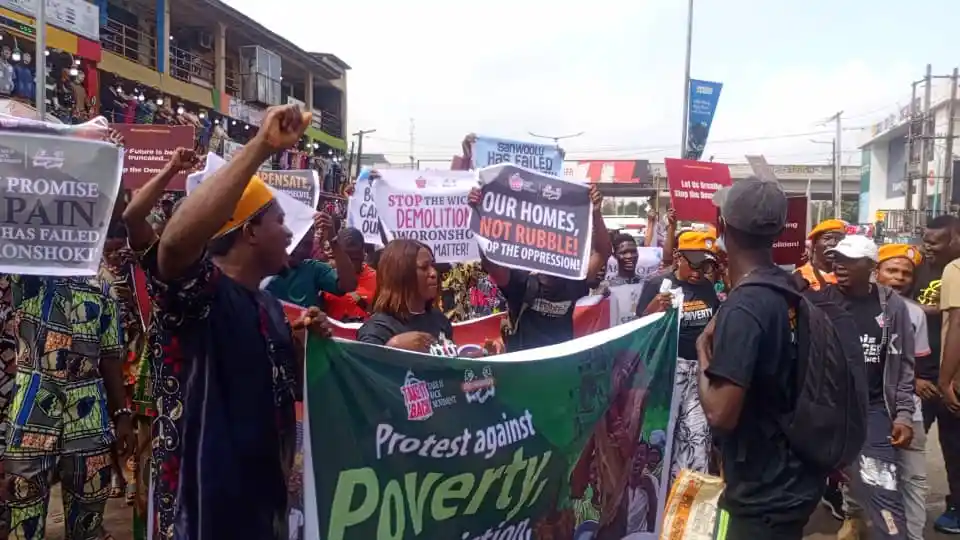
Hundreds of residents and civil society activists took to the streets of Lagos on Friday to protest against the demolition of homes in Oworonshoki and rising economic hardship, accusing the state government of neglecting poor communities.
The protesters, led by the Take It Back Movement and several human rights groups, began assembling around 7:30 a.m. at Ikeja Bridge before embarking on a march to Alausa, the seat of the Lagos State Government.
The demonstration, which officially kicked off at 10:00 a.m., drew large crowds holding placards with messages such as “Stop the Demolitions,” “End Hunger Now,” and “Housing Is a Human Right.”
The groups argued that the recent demolitions had displaced hundreds of families without proper resettlement or compensation.
They described the state’s actions as “anti-poor,” saying the exercise has worsened the living conditions of already struggling residents.
“We are here because people in Oworonshoki and other parts of Lagos are being thrown into the streets,” said one of the organisers. “The government cannot continue to destroy people’s homes in the name of development while ignoring their suffering.”
ALSO READ: Lagos State confronts illegal land reclamation agents
Security personnel, including officers from the Lagos State Police Command and the Lagos Neighbourhood Safety Corps, were heavily deployed along the protesters’ route. Their presence was to maintain peace and prevent any confrontation as the demonstrators advanced toward the state secretariat.
By mid-morning, the protesters had reached the Alausa Secretariat, chanting solidarity songs and calling for an audience with Governor Babajide Sanwo-Olu or his officials. They demanded an immediate halt to further demolitions and the creation of an emergency relief plan for displaced families.
Observers say the protest adds to growing public frustration over economic challenges and housing insecurity in Lagos, where recurring demolitions have sparked criticism of the government’s urban renewal policies.
Civil society groups have repeatedly accused authorities of prioritising elite-driven development projects at the expense of low-income residents. They argue that rather than displacing people, the government should invest in upgrading informal settlements and expanding access to affordable housing.
At press time, officials of the Lagos State Government had yet to respond to the protesters’ demands, but police maintained that the situation remained under control.
The demonstration underscores the mounting social tension in Nigeria’s commercial capital, where many residents continue to grapple with inflation, unemployment, and inadequate housing.
Premium Times