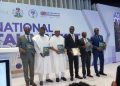
Oyo, Cross River and Kaduna states are to get their shares of the $540 million packaged by the African Development Bank, AfDB, for development of Special Agro-Industrial Processing Zones, SAPZs, in Nigeria.
The project’s initial phase of beneficiaries includes the three states. It was discovered yesterday that the stage is ready for the fund to be disbursed.
Vice President Kashim Shettima demanded quick action after receiving the hint. He declared that action by the government and its development partners is now necessary.
Stanley Nkwocha, the Senior Special Assistant to the President who works in the Vice President’s Office on Media and Publicity, released a statement that included these details.
As part of efforts by the federal government and the AfDB to guarantee food security in the nation, other states will receive their own portions of the funds.
Speaking after representatives of the AfDB and that of the United Nations Industrial Development Organisation (UNIDO) presented their separate reports on the status of projects being executed in Nigeria to him, Shettima called for immediate action.
He asserts that in order to guarantee that Nigerians receive President Bola Ahmed Tinubu’s visions, all hands must be on deck.
“We have passed the age of talking; we have to walk the walk,” stated the vice president. We need to make this work because no matter how much we talk, it will be meaningless if we do nothing. We simply have to.
“What comes to us matters more than what comes to the majority of people; we have not looked past the depths of our wallets. Things have to change.
READ ALSO: Ooni pacifies disengaged OAUTHC workers with N10m, 1,000 bags of rice
“I read a book on how Korea transformed itself with no natural resources, how they started producing steel against all odds, how they went into shipbuilding; and how Hyundai, Daewoo, Samsung, Kia came about. I believe that when there is a will there is always a way. We have to walk the talk.”
The Nattion reports that making AfDB’s presentation to Shettima, Prof Banji Oyelaran-Oyeyinka said: “The Special Agro-Industrial Processing Zones (SAPZ) is an initiative of the African Development Bank that is aimed at turning the rural landscape into economic zones of prosperity and harnessing the power of commercial agriculture and food.
“The primary objective is to support inclusive and sustainable agro-industrial development in Nigeria. The phase one of the project is at the point of disbursement. Kaduna, Oyo and Cross River States are all in the process of receiving disbursements and we hope for the other states, they can speed up with their documentation so that we can fast-track these states.
“We raised $540,000,000 in catalytic funding and we expect every state to find a partner that will bring equity and join up with them. It is a government-enabled project but private-sector driven.”
The SSA further explained to the AfDB President that the Federal Capital Territory (FCT) and seven states—Cross River, Imo, Kaduna, Kano, Kwara, Ogun, and Oyo—are implementing the first phase of SAPZs.

He went on, “Ogun State chose not to accept the loan after finding a partner for the project. In essence, we will disburse the loan to the other states. Next up is getting ready for phase two, which will involve 27 states. Despite the high demand, we must give priority to those who move quickly.
We have established the states’ eligibility standards and ranked them. We anticipate that they will provide an environmental impact study, a feasibility report, and a pledge of matching funds.
In another report on the visit to the Ajaokuta Steel Company Limited, inaugurated earlier by the vice president, the Head of Investment and Technology Promotion Office at the United Nations Industrial Development Organization, UNIDO, Mrs. Abimbola Olufore Wycliffe, said the recovery plan for the company would include revitalizing through rehabilitation, modernisation and expansion.
She said: “Single-phase turnaround for the entire plant is challenging due to heavy investments and a prolonged revenue generation timeline. Convert the integrated steel plant into Strategic Business Units , SBUs, to serve as profit centers.
“Conduct opportunity studies for each SBU, focusing on incremental investments, raw material availability, labor, utilities, and market demand. Prioritize SBUs with lower investments and quicker positive cash flows (the low-hanging fruits).”
She called for the reinvestment of profits from each SBU in ASC to reduce the burden of incremental investment on the local economy.
The UNIDO chief recommended the enhancement of foreign exchange earnings and contribution to local economy development.