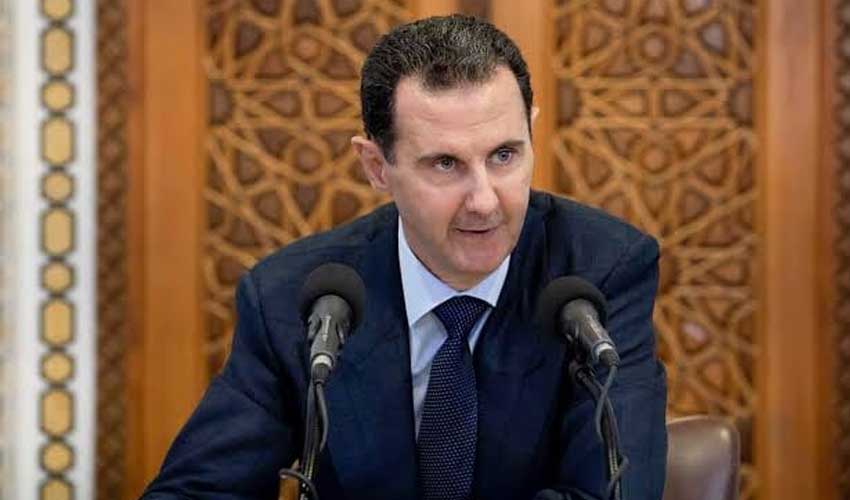
Syria’s ousted President Bashar al-Assad has arrived in Moscow, Russian state media has confirmed.
Mr Assad and members of his family arrived in the city on Sunday, a Kremlin source told the TASS news agency.
The source said: “Assad and his family members have arrived in Moscow. Russia, for humanitarian reasons, has granted them asylum.”
Al-Assad left the Syrian capital of Damascus after his government fell following a lightning offensive by anti-regime forces across the country – bringing his 24-year rule to an end.
His whereabouts, as well as those of his wife Asma and their two children, were initially unknown.
As al-Assad fled, footage on social media showed families gleefully ransacking presidential palaces in Damascus, with some taking selfies in the grand settings, as thousands celebrated in the streets.
In one of the most consequential turning points in the Middle East for generations, the fall of Assad’s government wiped out a bastion from which Iran and Russia exercised influence across the Arab world. Moscow gave him and his family asylum.
His sudden overthrow, at the hands of a Turkish-backed revolt with roots in jihadist Sunni Islam, limits Iran’s ability to spread weapons to its allies and could cost Russia its Mediterranean naval base.
It also may pave the way for millions of refugees scattered for more than a decade in camps across Turkey, Lebanon and Jordan to finally return home.
For Syrians, it brought a sudden unexpected end to a war that had been in deep freeze for years, with hundreds of thousands dead, cities pounded to dust, an economy hollowed out by global sanctions and seemingly no resolution in sight.
READ ALSO: Syrian president al-Assad flees as rebels enter Damascus
“How many people were displaced across the world? How many people lived in tents? How many drowned in the seas?” the top rebel commander Abu Mohammed al-Golani told a huge crowd at the medieval Umayyad Mosque in central Damascus, referring to refugees who drowned trying to reach Europe.
“A new history, my brothers, is being written in the entire region after this great victory,” he said. It would take hard work to build a new Syria which he said would be “a beacon for the Islamic nation”.
The Assad police state – known since his father seized power in the 1960s as one of the harshest in the Middle East with hundreds of thousands of political prisoners in its gulag – melted away overnight.
Bewildered and elated inmates poured out of jails after rebels blasted away the locks on their cells. Reunited families wept and wailed in joy.
Newly freed prisoners were filmed at dawn running through the Damascus streets holding up the fingers of both hands to show how many years they had been in prison.
“We toppled the regime!” a voice shouted and a prisoner yelled and skipped with delight.
Reuters.com