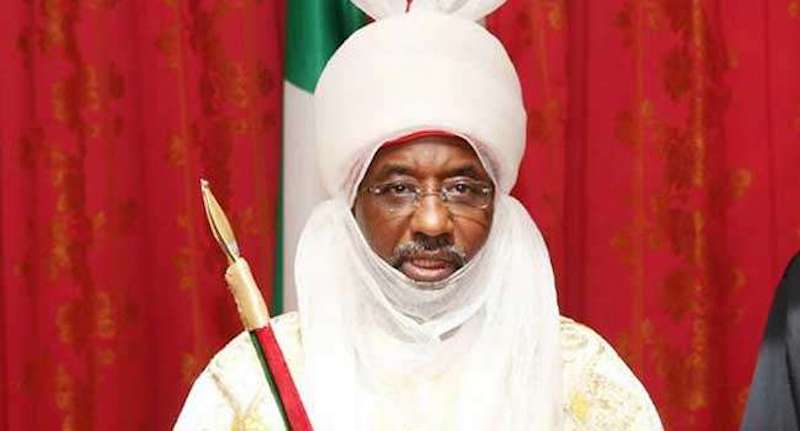
The Federal Government has criticized the Emir of Kano, Muhammadu Sanusi II, over his recent comments on the economic reforms of President Bola Ahmed Tinubu.
The government advised the Emir, a former Governor of the Central Bank of Nigeria to put aside personal interests and political biases and instead focus on the welfare of Nigerians.
These remarks, along with others were part of a statement issued by the Minister of Information and National Orientation, Mohammed Idris in response to recent statements made by the first-class monarch about Nigeria’s economic challenges.
READ ALSO: Tinubu defends policies, urges Nigerians to endure
Emir Sanusi’s Stance on Economic Issues
At the 21st Memorial Lecture for Chief Gani Fawehinmi in Lagos, the Emir reportedly stated that he would not offer any guidance to President Bola Tinubu’s administration on how to address the country’s economic difficulties.
He was quoted as saying: “I can give a few points here about what we are going through and how it was predictable and avoidable. But I am not going to do that.
“I have chosen not to speak on the economy, or reforms or to explain anything because if I explain it, it will help this government. But I don’t want to help this government. They are my friends, but if they don’t behave like friends I won’t behave like a friend.
“They don’t even have people with pedigree that can come and explain to the people what they are doing. I am not going to help. I started by helping but I am not going to help. Let them come and explain to Nigerians why they are pursuing the policies that they are pursuing.
“But I will say this one thing though. What we are going through today is at least in part, a necessary consequence of decades of irresponsible management. People were warning that if we continued the way that we were going, this is how we will end up but they refused to listen.
“Now, is everything being done correctly? No. When I am ready to talk about the economy, I will.”
Government’s Response to Emir Sanusi’s Remarks
In response to these remarks, the Minister of Information and National Orientation issued a statement titled: “We don’t need Sanusi’s stamp of approval for our laudable policies,” expressing disappointment over the Emir’s alleged negative comments about Tinubu’s reforms, citing his supposed “shift in loyalty.”
The statement read: “The Federal Government notes the recent remarks by His Highness, Emir Muhammadu Sanusi II, regarding the economic reforms introduced under President Bola Ahmed Tinubu’s administration, at a public event in Lagos. We note the emir’s acknowledgement of the noble initiatives which, he said; he could explain away but for his decision ‘not to help the government.’”
“First, we acknowledge that Sanusi, and indeed any Nigerian, has the inalienable right to express an opinion either in the form of commendation or criticism on how the government is being run. However, we find it amusing that a leader, especially one from an institution that upholds forthrightness, fairness, and justice, would publicly admit to withholding the truth due to personal interests tied to imaginary antagonism.
“It is important to state that Nigeria is at a critical moment where bold, decisive actions are required to address long-standing economic challenges. This administration has introduced transformative reforms not because they are simple, but because they are vital for ensuring Nigeria’s long-term stability and growth, goals that Emir Sanusi himself has consistently championed.
“The temporary hardships currently being experienced as a result of these necessary decisions, as Sanusi acknowledged, are a ‘necessary consequence of decades of irresponsible economic management’ more than anything else.
“These reforms are already yielding tangible results. The unification of exchange rates has strengthened investor confidence, leading to higher foreign reserves and enhanced Nigeria’s ability to protect itself from external economic shocks.
“The removal of the fuel subsidy has released substantial funds, enabling increased investment in critical sectors such as infrastructure, education, and healthcare. Projections from respected institutions, including the World Bank, indicate that Nigeria’s GDP is on an upward trajectory, suggesting that the economy is firmly on the road to recovery.”
“Moreover, by addressing inefficiencies, the country has reduced its debt service-to-revenue ratio, establishing a more sustainable fiscal structure for future generations.”
The statement continued: “It is deeply disappointing that reforms widely acknowledged as essential by global experts—including by Emir Sanusi II himself—are now being subtly criticized by him due to a shift in loyalty. His Highness, with his background in economics, holds a unique responsibility to contribute positively, rather than undermine reforms aimed at collective progress, simply because he feels distanced from his ‘friends’ in government.”
Crediblenewsng.com