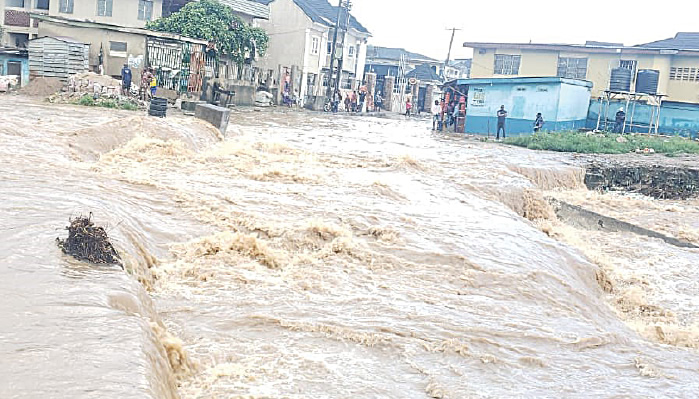
The National Emergency Management Agency, NEMA, has urged residents in Rivers and Bayelsa to move to higher ground due to impending floods.
At a news conference in Port Harcourt on Friday, the South-South Zonal Coordinator of NEMA, Mr. Eric Ebhodaghe, raised the alarm over the likelihood of severe flooding in the two states, especially as the rainy season intensifies.
He referenced the Nigerian Meteorological Institute’s recent forecast that predicted heavy flooding across 30 states, with coastal areas expected to be among the hardest hit.
“Bayelsa and Rivers are at high risk of flooding this season,” he said. “We are working to reduce the impact by sensitising residents and promoting early relocation to safer areas.”
Ebhodaghe explained that the agency had commenced flood mitigation efforts, including identifying flood-prone communities across various local government areas and raising awareness on precautionary measures.
He said NEMA had already activated collaboration with federal, state, and local governments to coordinate emergency responses.
READ ALSO: Flood alert: 30 states, FCT face high risk
“We are visiting vulnerable communities to educate residents on flood preparedness. While we can’t stop the floods, we can manage them by urging people to relocate to safe areas and IDP camps,” he said.
The zonal coordinator emphasised the importance of prevention in disaster management, noting that 15 highly vulnerable LGAs in Rivers have already had IDP camps established.
He added that NEMA was engaging community leaders, youth representatives, and the State Emergency Management Agency to strengthen local response strategies.
“Our discussions with traditional rulers and Community Development Committees have centred on proactive actions, including proper waste disposal and drainage maintenance,” Ebhodaghe said.
He further advised residents to regularly clear blocked drainage channels to allow free flow of rainwater, thereby minimising the risk of flood-related damage.
“When drainages are clogged, water will find alternative routes, often leading to destruction. Proper waste management is critical to controlling flood impact,” he warned.