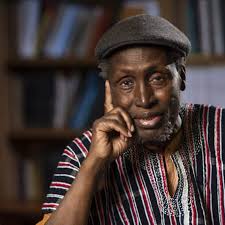
Celebrated Kenyan author, playwright, and literary scholar Ngũgĩ wa Thiong’o, whose powerful works championed African languages and anti-colonial thought, has passed away at the age of 87.
His daughter, fellow writer Wanjiku wa Ngugi, announced his death in a heartfelt post on Facebook, revealing that he died peacefully on the morning of Wednesday, May 28, 2025.
Describing him as a “warrior for words,” Wanjiku urged people to celebrate his extraordinary life and the ideals he stood for. “He lived a full life, and he fought a good fight,” she wrote, prompting an outpouring of tributes from authors, academics, activists, and fans around the world.
Born as James Ngugi in Limuru, Kenya, in 1938, Ngũgĩ wa Thiong’o rose to prominence in the 1960s as one of East Africa’s first major post-independence novelists.
He gained early recognition for novels like Weep Not, Child (1964) and The River Between (1965), which explored the tensions between tradition and modernity, colonial rule, and indigenous resistance.
In the 1970s, Ngũgĩ made a radical shift from writing in English to Gikuyu, his native language, as a form of cultural and political resistance. His landmark essay collection, Decolonising the Mind (1986), became a seminal text in post-colonial studies, challenging African writers to embrace indigenous languages and reject linguistic colonialism.
READ ALSO: Ngugi Wa Thiongo’s son discloses family struggles, accuses father of physically abusing his mum
Ngũgĩ’s activism often came at a personal cost. In 1977, following the release of his politically charged play Ngaahika Ndeenda (I Will Marry When I Want), he was imprisoned by the Kenyan government without trial. While in detention, he famously wrote Devil on the Cross on toilet paper using a ballpoint pen—an act that became a symbol of literary defiance.
Forced into exile in the early 1980s, Ngũgĩ spent decades teaching abroad, including at Yale, New York University, and finally the University of California, Irvine, where he served as Distinguished Professor of English and Comparative Literature.
Despite being exiled, he remained a tireless advocate for African unity, justice, and cultural self-determination. His fiction, non-fiction, and academic work earned him numerous international honors, including the Nonino International Prize for Literature, the Nicolás Guillén Lifetime Achievement Award for Philosophical Literature, and frequent nominations for the Nobel Prize in Literature.
He returned to Kenya in 2004 for the first time in over two decades, though his visit was marred by an armed robbery and assault, highlighting the complexities of returning home as a political exile.
Ngũgĩ wa Thiong’o is survived by his children and grandchildren, many of whom are also involved in the arts and literature.
His legacy lives on through his numerous books, his critical essays, and his profound influence on African literature, global academia, and post-colonial thought.
TheConclave